All Categories

VESC (100A~3000A) > Entry Series
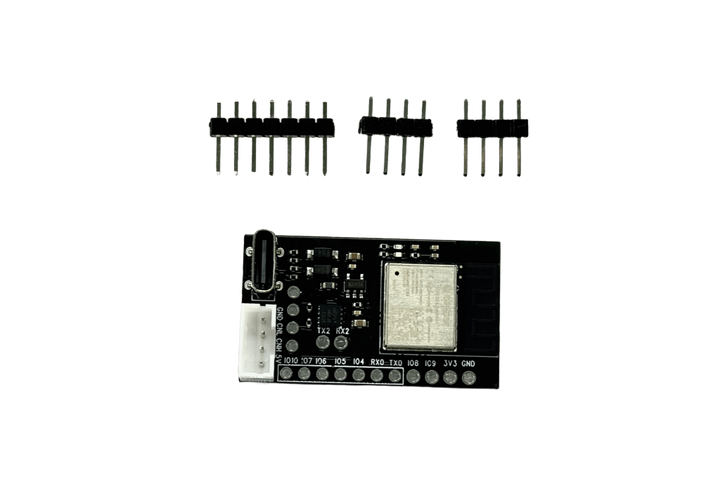
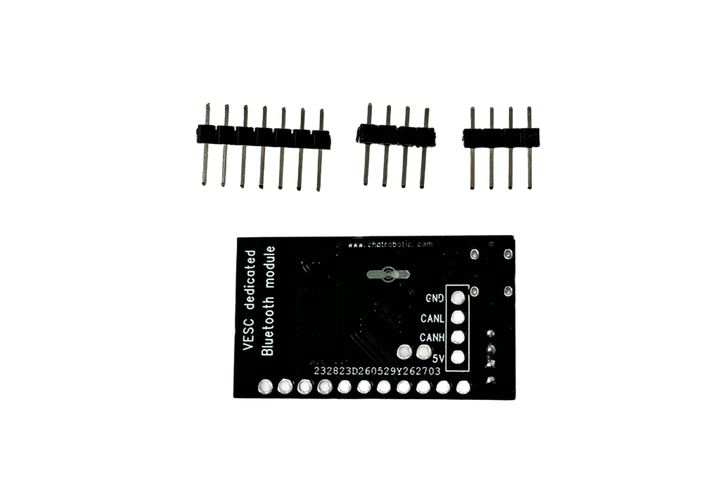
The VESC CAN Bus Bluetooth Module is a compact wireless communication add-on built around the official ESP32-C3 Bluetooth module, providing flexible CAN bus connectivity and expansion headers for VESC-based motor controllers.
| Parameter | Value |
|---|---|
| Product Name | VESC CAN Bus Bluetooth Module |
| Bluetooth Module | ESP32-C3 (official standard module) |
| Power Supply | USB or PH2.0 interface |
| CAN Interface | 2 ports: PH2.0 connector and DuPont-wire connector |
| GPIO | 7 reserved GPIO pins |
| Serial Port (UART) | 1 group |
| 3.3V Power Port | 1 group |
| Dimensions (L × W) | 36 × 21 mm |
• Core Module: Built on the official standard ESP32-C3 Bluetooth module for reliable wireless communication.
• Form Factor: Compact printed-circuit-board design, 36 × 21 mm.
• Dual CAN Interface: Provides both a PH2.0 connector and a DuPont-wire connector for flexible wiring to VESC controllers.
• Expansion Headers: Reserved 7 GPIO pins, 1 UART group, and 1× 3.3V power port for custom extensions.
• Wireless Communication: Integrated ESP32-C3 Bluetooth for wireless tuning, telemetry, and configuration.
• Power Input: Supports power supply via USB or PH2.0 interface.
• CAN Bus: Two CAN interfaces (PH2.0 and DuPont) for connecting to VESC controllers and other CAN devices.
• Expansion Support: 7 GPIO, 1 UART group, and 1× 3.3V power port for DIY add-ons.
• Compatibility: Works with VESC-based motor controllers for wireless control and monitoring.
• Power Input Protection: Safe operation with USB or PH2.0 power input (3.3V/5V domain).
• Interface Caution: Avoid hot-plugging CAN and GPIO headers while powered to prevent damage.
• Stable Connection: Official ESP32-C3 module ensures stable Bluetooth pairing and data transfer.
• USB / PH2.0 (Power): Supplies power to the module; choose either the USB port or the PH2.0 power connector.
• CAN Port ×2: PH2.0 connector and DuPont-wire connector — both route to the same CAN bus for connecting to VESC controllers or other CAN nodes.
• GPIO ×7: Reserved general-purpose I/O pins for custom peripherals or firmware extensions.
• UART ×1: A serial port group for debugging or connecting external serial devices.
• 3.3V Power Port ×1: Provides a regulated 3.3V output for powering low-power add-on components.