

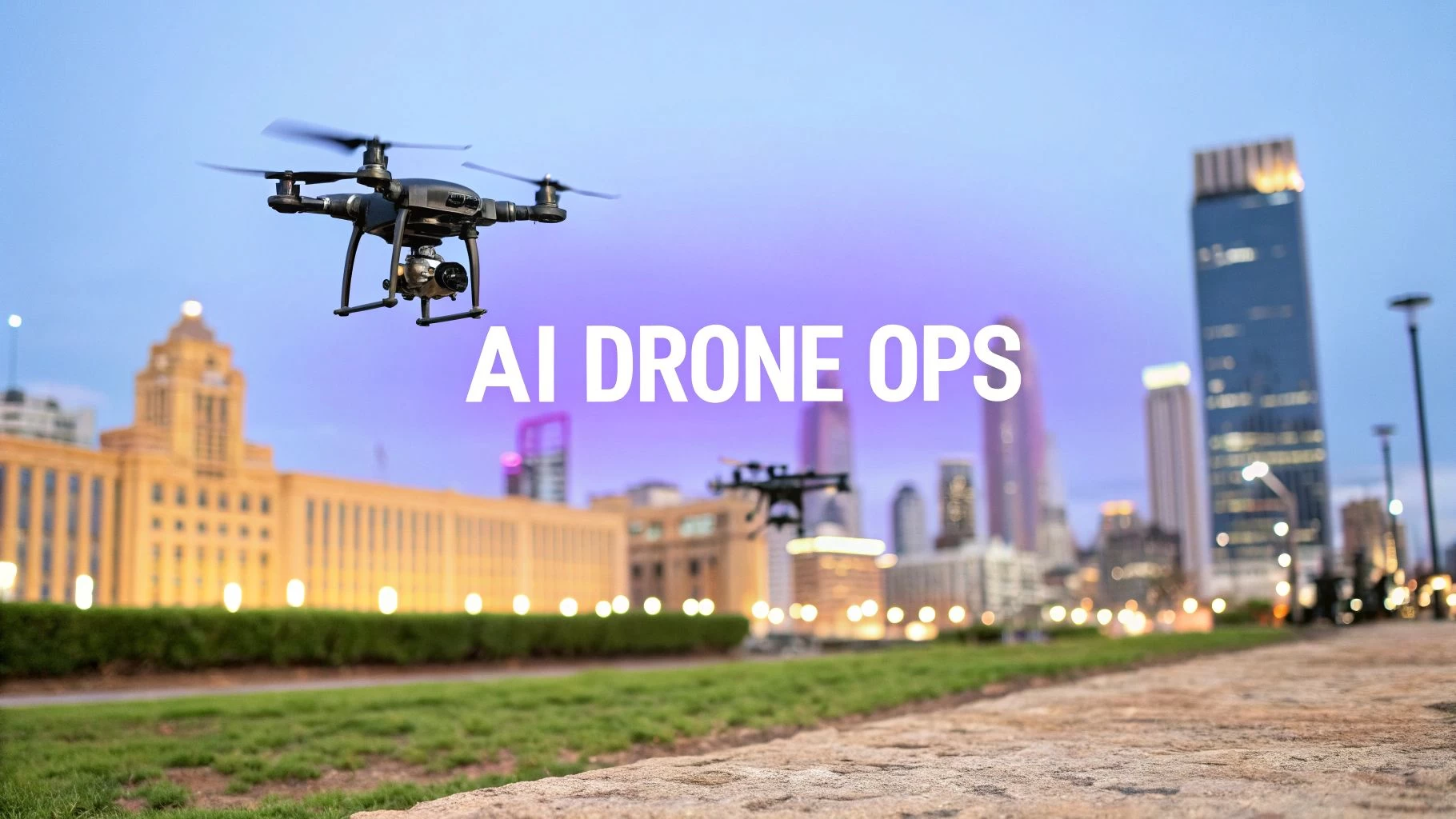
AI Autonomous Drone Navigation 2025: The Complete Guide to Next-Gen UAVs
The future of drone technology is arriving faster than expected. By 2025, artificial intelligence is fundamentally transforming how drones perceive, navigate, and make decisions in complex environments—without human intervention or traditional GPS dependency. From disaster response to urban air mobility, AI-powered autonomous navigation enables drones to operate in challenging conditions where traditional systems fail. This comprehensive guide explores the breakthrough technologies, cutting-edge research, and real-world applications defining the future of autonomous drone navigation in 2025 and beyond.
Why AI Navigation is Revolutionizing Drone Technology
Traditional drone navigation relies heavily on GPS, predefined waypoints, and often remote human pilots. This approach fails spectacularly in GNSS-denied environments (where GPS signals are unavailable or jammed), dynamic obstacles, and complex terrains. AI-powered navigation solves these limitations by enabling drones to:
• Perceive and interpret their environment in real-time using advanced sensors
• Make intelligent decisions without human intervention
• Adapt to changing conditions and unexpected obstacles
• Navigate precisely without GPS dependency
• Coordinate with other drones in collaborative swarms
The results are drones that can operate autonomously in complex scenarios like disaster zones, dense urban environments, and indoor spaces where traditional navigation would fail
Breakthrough Technologies Powering 2025's Autonomous Drones
1. Advanced Sensor Fusion and Perception Systems
2025's autonomous drones employ sophisticated sensor suites that far exceed human capabilities:
• Photonics Radar Arrays: Next-generation 128-line solid-state LiDAR systems with 0.0015° angular resolution and 1.2km detection range
• Quantum-Enhanced Infrared Sensors: Enable operation in complete darkness, fog, smoke, and other visually challenging conditions between -50°C to +80°C
• Bio-Inspired Vision Systems: Retina-like CMOS sensors with 160dB dynamic range (100x greater than human eyes) capable of processing optical flow fields with less than 2ms latency
• Cross-Modal Learning: AI systems that can "see through" adverse weather conditions by fusing multiple sensor inputs and leveraging prior environmental knowledge
2. Differentiable Physics and End-to-End Learning
A revolutionary approach from Shanghai Jiao Tong University replaces traditional modular navigation stacks with compact end-to-end neural networks trained through differentiable physics simulations
This breakthrough technology:
• Uses ultra-low-resolution depth cameras (12×16 pixels) similar to insect compound eyes
• Employs tiny 3-layer convolutional neural networks with only 2MB parameters
• Runs on $21 embedded computing boards without GPUs
• Enables flight speeds up to 20m/s (72 km/h) in complex environments
• Achieves 90% navigation success rate in unknown environments
The system learns flight control directly through physics-based simulation, requiring no expert demonstration data or real-world flight logs for training
3. Vision-Language Navigation for High-Level Reasoning
Beijing Aerospace University's pioneering AeroDuo system enables dual-drone collaboration where a high-altitude UAV with a multimodal large language model (Pilot-LLM) performs target reasoning while a low-altitude UAV handles precise navigation and target localization
This approach allows drones to:
• Understand natural language instructions for navigation
• Interpret complex spatial relationships
• Collaborate without explicit communication
• Reason about optimal paths and strategies
4. Distributed Decision-Making and Swarm Intelligence
2025's most advanced drone systems employ distributed decision engines that enable sophisticated coordination without central control.Key innovations include:
• Airspace Cognitive Digital Twins: Creating million-voxel environmental models per square kilometer
• Advanced Optimization Algorithms: Using improved NSGA-III algorithms to simultaneously optimize energy consumption, safety margins, and airspace efficiency
• Self-Organizing Behaviors: Enabling emergent coordination without explicit communication, as demonstrated by Shanghai's drone swarms
5. Resilient Navigation in GNSS-Denied Environments
Companies like Beijing Bolunce Navigation Technology are developing advanced solutions for navigation when GPS signals are unavailable. Their NAV100 integrated navigation system combines:
• High-performance MEMS inertial measurement units
• System-wide high-precision positioning and orientation modules
• Visual positioning systems that match real-time images with pre-existing maps
This fusion allows drones to maintain accurate positioning even when GPS signals are blocked or jammed.
Real-World Applications Transforming Industries
Disaster Response and Emergency Services
AI-navigated drones can penetrate smoke, fog, and debris to locate survivors, assess damage, and deliver critical supplies in disaster zones where human responders cannot safely operate
Infrastructure Inspection and Monitoring
Autonomous drones can navigate complex structures like bridges, wind turbines, and power lines, identifying defects and maintenance needs with millimeter precision without human guidance
Urban Air Mobility and Delivery Services
Next-generation delivery drones can navigate dense urban environments, avoiding buildings, wires, and other obstacles while optimizing routes in real-time based on weather and air traffic conditions
Defense and Security Applications
Autonomous drones can perform complex intelligence, surveillance, and reconnaissance missions in contested environments where GPS jamming and other countermeasures are employed
Agricultural Monitoring and Precision Farming
AI-enabled drones can autonomously navigate fields, monitoring crop health, applying precise treatments, and collecting data over large agricultural areas with minimal human intervention.
The Technical Challenges Still Being Solved
While progress has been remarkable, significant challenges remain:
1. Energy Efficiency: Balancing computational requirements with power consumption to extend mission durations
2. Regulatory Compliance: Meeting evolving aviation authority requirements for autonomous operations
3. Edge Case Handling: Improving performance in extremely rare or novel situations.
4. Adversarial Robustness: Ensuring systems cannot be easily fooled or hacked
5. Cross-Domain Adaptation: Enabling models trained in simulation to perform reliably in diverse real-world environments.
Future Trends: What's Next After 2025?
The evolution of autonomous drone navigation continues to accelerate:
• Neuromorphic Computing: Hardware specifically designed for neural network processing, dramatically improving efficiency and response times
• Quantum-Enhanced Sensing: Utilizing quantum phenomena for unprecedented measurement precision
• Self-Evolving Systems: Drones that can continuously learn and adapt their behavior based on experience
• Human-AI Collaboration Frameworks: Intuitive interfaces that allow humans to guide and supervise autonomous systems at scale
• Quantum-Secure Communication Networks: Ensuring safe and reliable drone-to-drone and drone-to-ground communication even against advanced threats
Getting Started with AI Autonomous Navigation
For developers and companies looking to integrate these technologies, consider these starting points:
1. Simulation Environments: Begin with platforms like OpenUAV that provide realistic physical simulation for training and testing navigation algorithms
2. Open-Source Frameworks: Explore available libraries and frameworks for autonomous navigation, many of which are now openly available.
3. Modular Integration: Start by enhancing existing drone systems with specific autonomous capabilities rather than complete overhauls.
4. Specialized Hardware: Evaluate the growing range of processors and sensors specifically designed for AI navigation tasks.
Conclusion: The Autonomous Future is Here
The year 2025 represents a watershed moment for autonomous drone navigation. Through breakthroughs in AI, sensor technology, and computational efficiency, drones have gained unprecedented abilities to navigate complex environments without human guidance. These advancements are opening new applications across industries while making drone operations safer, more efficient, and more capable.
As these technologies continue to evolve, we're moving toward a future where autonomous drones become ubiquitous tools that seamlessly integrate into our airspace, performing tasks that are too dangerous, difficult, or tedious for humans—all while navigating with a precision and reliability that rivals biological pilots.
Which AI navigation application excites you most? Share your thoughts in the comments below and subscribe for updates on the latest autonomous drone technologies!
{{ commentCount }} Comments
Loading comments...
{{ comment.user.fullname }}
No comments yet. Be the first to comment!