
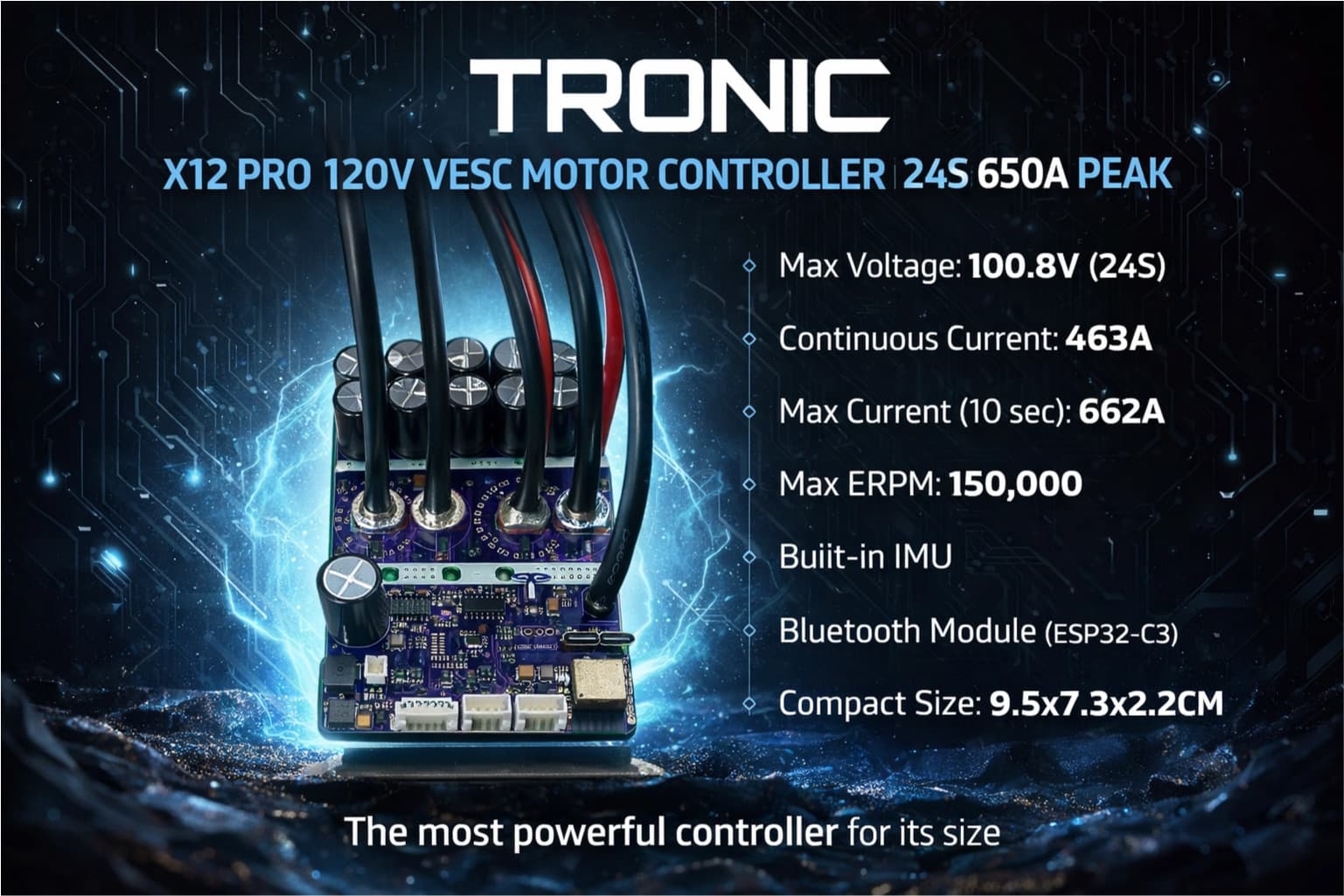
Choosing the right VESC (Vedder Electronic Speed Controller) motor controller is a critical decision for any DIY electric project, whether you're building an electric skateboard, e-bike, or a custom robot. The VESC ecosystem offers unparalleled flexibility and performance, but with numerous options available, selecting the ideal controller can be daunting. This guide will walk you through the essential factors to consider, ensuring you make an informed choice that perfectly matches your project's needs and maximizes its potential.
Understanding Your Project's Requirements
Before diving into specific VESC models, clearly define your project's core requirements. This foundational step will narrow down your options significantly.
1. Application Type
Different applications demand different characteristics from a motor controller. For instance:
-
• Electric Skateboards/Longboards: Often require compact, dual-motor setups with robust current handling for acceleration and braking. Reliability and thermal management are key due to high power demands in a small enclosure.
-
• E-bikes/Electric Scooters: May need higher voltage support and continuous power output, especially for hill climbing. Integration with pedal-assist systems (PAS) or throttle inputs is crucial.
-
• Robotics/Industrial Applications: Can range from precise position control (where VESC excels in FOC mode) to high-torque, heavy-duty operations. Durability and specific communication protocols (e.g., CAN bus) are often prioritized.
-
• Electric Unicycles (EUCs): Demand extremely reliable and responsive controllers, often with integrated IMUs for balancing, and capable of handling high peak currents.
2. Voltage and Current Ratings
These are perhaps the most critical electrical specifications. Your VESC must be compatible with your battery pack's voltage (S-rating) and capable of supplying the continuous and peak currents your motor(s) will draw.
-
• Voltage (S-rating): VESC controllers are typically rated for a maximum cell count (e.g., 12S, 16S, 20S, 40S). Ensure your chosen VESC supports your battery's voltage. Exceeding this can lead to immediate failure.
-
• Continuous Current: This indicates the current the VESC can safely handle over extended periods without overheating. Match this to your motor's continuous current draw under load.
-
• Peak Current: Represents the maximum current the VESC can deliver for short bursts (e.g., during acceleration or steep climbs). Higher peak current ratings provide more dynamic performance.
Key VESC Features to Consider
Beyond basic compatibility, several features differentiate VESC controllers and impact their suitability for various projects.
1. Thermal Management
High power applications generate significant heat. Effective thermal management is crucial for reliability and longevity. Look for VESCs with:
-
• Robust Heatsinks: Larger, finned heatsinks dissipate heat more effectively.
-
• Active Cooling: Some high-end VESCs include integrated fans or provisions for external cooling solutions.
-
• Temperature Sensors: Essential for monitoring VESC temperature and implementing thermal throttling to prevent damage.
2. Form Factor and Size
Space constraints are common in DIY projects. Consider the physical dimensions of the VESC and whether it will fit comfortably within your enclosure. Dual VESCs (two controllers on one PCB) can offer a compact solution for multi-motor setups.
3. Connectivity and Communication
VESC controllers offer various input and output options:
-
• USB: For configuration and real-time data logging via VESC Tool.
-
• UART: For connecting external modules like Bluetooth, GPS, or custom microcontrollers.
-
• CAN Bus: Essential for multi-VESC setups (e.g., dual-motor electric skateboards) to synchronize control and share data.
-
• PPM/PWM: Standard for connecting traditional RC receivers or throttles.
-
• ADC: For analog inputs like potentiometers or hall effect throttles.
-
• GPIO: General Purpose Input/Output pins for custom sensors or controls.
4. Software and Firmware Support
One of VESC's greatest strengths is its open-source software ecosystem. Ensure the VESC model you choose is well-supported by the latest VESC Tool software and firmware updates. This guarantees access to new features, bug fixes, and community support.
5. Reliability and Brand Reputation
While VESC is open-source, many manufacturers produce VESC-based hardware. Research brand reputation and read reviews from other DIY builders. Some brands are known for their robust designs and quality control, while others might offer more budget-friendly but potentially less reliable options.
Popular VESC Options and Their Niche
While specific recommendations can change rapidly, here's a general overview of popular VESC categories and their typical applications:
-
• Entry-Level/Budget-Friendly: Often suitable for smaller, less demanding projects or beginners. May have lower current ratings or less advanced thermal solutions. Examples might include certain Flipsky or MakerX models.
-
• Mid-Range/Versatile: A good balance of performance, features, and price. Ideal for most electric skateboards, e-bikes, and general robotics. Many reputable manufacturers offer excellent options in this category.
-
• High-End/High-Power: Designed for extreme performance, high voltage (e.g., 20S, 40S) and high current applications (e.g., 200A+). These often feature advanced thermal designs and premium components, such as some Spintend Ubox or custom high-voltage VESCs.
Conclusion
Choosing the best VESC motor controller for your DIY electric project boils down to a careful assessment of your project's specific needs, understanding the technical specifications, and considering the features that matter most to you. By prioritizing voltage and current compatibility, thermal management, form factor, and robust software support, you can confidently select a VESC that will power your creation reliably and efficiently. Remember to always consult the VESC Project documentation and community forums for the latest information and support.

{{ commentCount }} Comments