
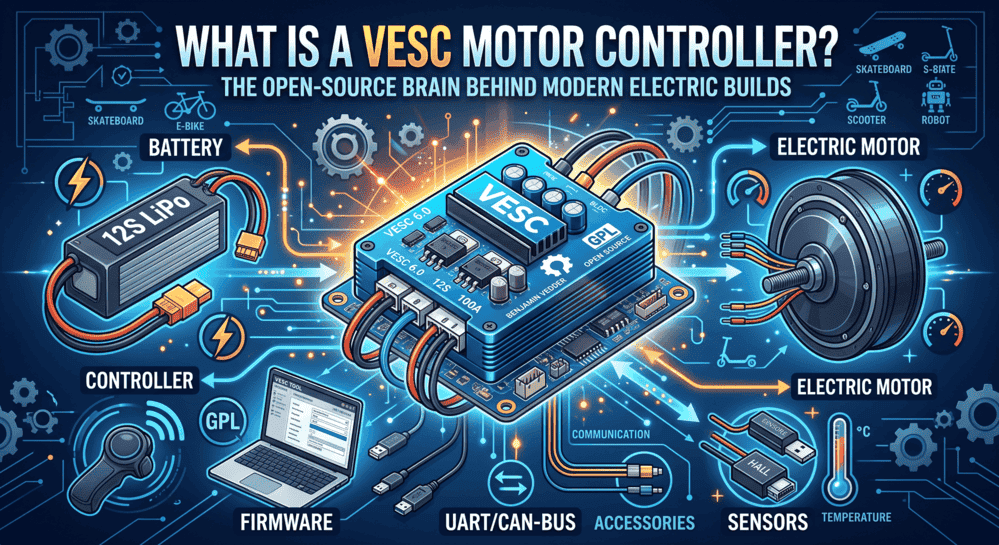
A VESC motor controller (Vedder Electronic Speed Controller) is an open-source motor controller designed for BLDC and PMSM motors using Field-Oriented Control (FOC). Unlike basic ESCs, a VESC exposes key motor parameters—such as current limits, throttle curves, regenerative braking, and live telemetry—for precise tuning via the VESC Tool software. Created by Benjamin Vedder, it powers electric skateboards, e-bikes, robotics, and industrial systems.
What Does VESC Stand For?
VESC stands for Vedder Electronic Speed Controller. Released under the open-source GPL v3 license, its firmware and hardware ecosystem remain free to modify and audit. This open heritage ensures continuous community-driven feature updates and broad compatibility across custom builds.
How Does a VESC Motor Controller Work?
A VESC regulates power flow between the battery and the motor using three core components:
• Microcontroller: Processes input signals (remotes, throttles, CAN bus, Arduino/Raspberry Pi) to govern motor behavior.
• Field-Oriented Control (FOC): Mathematically aligns current with the motor's magnetic field for smooth torque, quiet operation, and high efficiency.
• PWM Switching: Modulates phase voltage in real time to manage acceleration, speed, and braking.
Integrated protection mechanisms—including thermal throttling and voltage cutoffs—safeguard the drive system. It supports both sensored (Hall/encoder) and sensorless setups while streaming live telemetry (RPM, watt-hours, duty cycle) to the VESC Tool.
VESC Motor Controller vs. Standard ESC
| Feature | Standard ESC | VESC Motor Controller |
Firmware | Closed, static | Open-source, updateable (GPL v3) |
Tuning | Limited or non-existent | Full parameter access via VESC Tool |
Motor Support | Frequently sensored-only | Sensored + Sensorless (FOC) |
Telemetry | Rare | Real-time logging & streaming |
Automation | No | Yes (CAN, UART, custom apps) |
Common Applications
• Electric Skateboards & Longboards: Dual setups providing precise current delivery and regenerative braking.
• E-Bikes & Scooters: High-voltage support featuring smooth throttle response and pedal-assist integration.
• Electric Unicycles (EUCs): High peak current handling paired with IMU-based balancing algorithms.
• Robotics & AGVs: Accurate position control via FOC with industrial CAN bus integration.
• Industrial & Marine Drives: Custom firmware configurations applied to pumps, winches, and hydrofoils.
Key Advantages
• Open-Source Ecosystem: Free software toolchain backed by global development.
• Custom Parameter Tuning: Adjust current, top speed, braking response, and voltage cutoffs.
• Broad Connectivity: Interfaces via USB, UART, CAN bus, PPM/PWM, ADC, and GPIO.
• Active Thermal Management: Heat sinking with software-level thermal throttling.
Selecting the Right VESC Controller
When choosing a VESC, consider these primary specifications:
1. Voltage Rating (S-Rating): Match the controller's limit to your battery pack (e.g., 12S, 16S, 24S+).
2. Continuous & Peak Current: Ensure sufficient headroom above the motor's peak draw under maximum load.
3. Form Factor: Single vs. dual-motor designs based on enclosure space constraints.
Power Class Quick Reference
• 200A–500A Class: E-bikes, scooters, and light robotics.
• 1000A Class: High-performance electric skateboards, EUCs, and light EVs.
• 2000A Class: Electric motorcycles and industrial-grade equipment.
Recommended Hardware: ChatRobotic's TRONIC 250R 24S 280A offers high-efficiency control for mid-range builds. Higher power configurations include the TRONIC X12 PRO (24S 662A) and TRONIC1000 24S 1000A. View the complete VESC Product Range or read our VESC Selection Guide.
Getting Started with VESC Tool
1. Connect the VESC to a computer or mobile device via USB or Bluetooth.
2. Launch VESC Tool and run the Motor Configuration Wizard.
3. The wizard automatically measures inductance, resistance, and sensor configuration.
4. Fine-tune input curves, safety thresholds, and telemetry options.
Frequently Asked Questions
What is a VESC controller in simple terms?
It is an open-source, highly programmable motor controller that uses FOC algorithms to drive BLDC and PMSM electric motors smoothly and efficiently.
What is the advantage of VESC over a standard ESC?
Unlike standard ESCs, a VESC provides full access to motor parameters, real-time telemetry, advanced field-oriented control, and open-source software customization.
Can a VESC run sensorless motors?
Yes. VESC controllers support sensorless operation using FOC back-EMF tracking, as well as hybrid configurations that transition from sensored startup to sensorless high-RPM operation.
Conclusion
The VESC motor controller serves as the primary open-source control platform for high-performance electric drive systems. Its implementation of FOC, comprehensive parameter customization, and robust community software make it a standard choice for custom EVs, robotics, and industrial motion control.
Explore ChatRobotic's ISO-Certified VESC Controllers (200A–2000A) or contact our team for OEM/ODM engineering support.

{{ commentCount }} Comments