
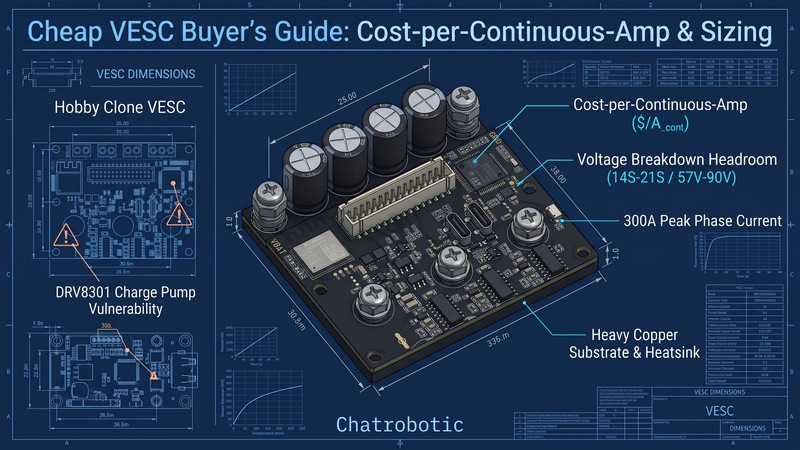
Quick Takeaway (TL;DR): A dependable "cheap VESC" is defined by Cost-per-Continuous-Amp and voltage breakdown headroom rather than upfront sticker price. While sub-$80 generic 4.12/6.6 clones on thin FR4 substrates frequently suffer DRV8301 charge-pump punctures at 12S, modern production inverters starting at $59 (single-drive) and $99 (dual-drive) deliver genuine 14S–21S (57V–90V) margins and 300A peak phase capability, reducing Total Cost of Ownership (TCO) by over 60%.
1. The Anatomy of a "Cheap VESC": Why $70 Clones Fail at 12S
When builders, light electric vehicle (LEV) startups, and robotics developers search for a "cheap VESC," marketplaces typically surface sub-$80 clones based on legacy VESC 4.12 or unoptimized VESC 6.6 hardware schematics. While an initial $65 to $80 purchase price appears economical on a preliminary Bill of Materials (BOM), deploying these units in 48V–60V powertrains routinely leads to bench fires or sudden field cutouts.
These failures stem from four fundamental hardware compromises inherent to cut-rate manufacturing:
•Thin 2-Layer Copper Substrates: Low-tier clone fabricators utilize standard 1 oz or 2 oz copper foil on generic FR4 glass-epoxy boards. The cross-sectional trace area is insufficient to carry rated currents, causing rapid I^2*R trace heating. A board marketed as "50A continuous" often thermally derates down to 18A–25A continuous when enclosed in an unventilated chassis bay.
•The DRV8301/8302 Charge-Pump Bottleneck: Budget controllers bundle gate driving, buck regulation, and current-sense amplification onto a single legacy IC (DRV8301). On standard 12S lithium packs (50.4V fully charged), wire lead parasitic inductance generates transient voltage spikes during high-rate switching: V_spike = V_pack + [L_lead × (di/dt)] These spikes exceed the 60V absolute maximum rating of the DRV chip, puncturing the internal charge pump and triggering high-side/low-side cross-conduction (shoot-through) that destroys the MOSFET bridge.
•Marginal 60V-Rated MOSFETs: Operating a 50.4V (12S) battery on 60V breakdown-voltage (V_ds) MOSFETs leaves less than 16% safety headroom for back-EMF spikes during high-speed regenerative braking, inviting avalanche breakdown.
•The "Hidden Accessories" Tax: Generic bare boards omit onboard Bluetooth, integrated Inertial Measurement Units (IMUs), and CAN wiring harnesses. Sourcing external dongles ($15–$25), IMU sensor boards ($20–$30), and anti-spark switches ($15–$20) drives the true system cost beyond $130, invalidating the initial discount.
When a $75 clone fails under torque, the downtime, replacement shipping, and collateral damage to motor windings or lithium packs make cut-rate clones the most expensive controllers per operating hour.
2. The Cost-per-Continuous-Amp Metric: True Economic Evaluation
To objectively assess value in power electronics, engineers calculate two foundational figures: Cost-per-Continuous-Amp ($/A_cont) and Junction-to-Ambient Thermal Rise (Delta_T).
Metric 1: Cost-per-Continuous-Amp ($/A_cont)
Marketing literature frequently touts burst phase current (e.g., "100A for 5 seconds") while concealing continuous thermal thresholds. The economic efficiency of an inverter is expressed by: Cost_per_Amp = Purchase_Price ÷ Verified_Continuous_Phase_Current
A $70 generic clone that overheats and throttles at 25A continuous yields: $70 ÷ 25A = $2.80 per Continuous Amp
In contrast, an optimized $59 production-grade inverter that sustains 120A continuous yields: $59 ÷ 120A = $0.49 per Continuous Amp
The dedicated production controller delivers over five times the usable current output per dollar spent.
Metric 2: Thermal Resistance & Heat Rejection Path
MOSFET junction temperature rise is governed by total conduction losses and thermal resistance: Junction_Temperature_Rise = 3 × I_rms^2 × R_ds(on) × (R_th_jc + R_th_cs + R_th_sa)
•Low-Cost FR4 Clones: Junction-to-case thermal resistance (R_th_jc) typically exceeds 1.8 °C/W to 2.5 °C/W. Without direct thermal vias or integrated baseplates, heat builds rapidly in the board core.
•Direct-Thermal Baseplates & Heavy Copper: Keeps total thermal resistance below 0.45 °C/W, dissipating conduction losses directly into the mounting structure and eliminating current throttling under sustained inclines.
3. Real Hardware Benchmark: Generic Clones vs. ChatRobotic Entry Series
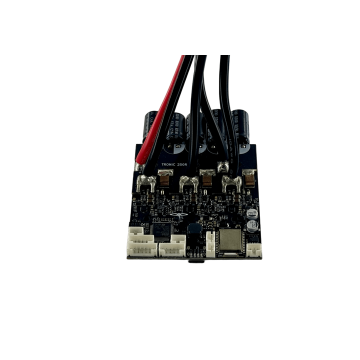
A dependable controller does not require an industrial budget. Real-world inventory data from the ChatRobotic VESC (100A~3000A) catalog demonstrates that factory-direct production units start at $59.00, delivering 14S to 27S headroom at lower unit costs than generic marketplace clones:
| Metric / Specification | Sub-$80 Generic Hobby Clone | VESC-LS 57V (14S) 300A V4 | Dual VESC-LS 57V (14S) 300A | VESC-S 90V (21S) 300A V2 | TRONIC 250R 125V 300A |
| Retail Price | $65.00–$80.00 | $59.00 | $99.00 ($49.50/axis) | $129.00 | $150.00 |
| Max Bus Voltage | 50.4V (12S Max, fragile) | 57.0V–58.8V (14S Rated) | 57.0V–58.8V (14S Rated) | 90.0V (21S Rated) | 125.0V (27S Rated) |
| Peak Phase Current | 50A–100A burst | 300A Peak | 300A Peak Total | 300A Peak | 300A Peak |
| Continuous Current | 18A–25A continuous | 100A–120A continuous | 120A/ch (240A total) | 120A continuous | 150A continuous |
| Cost-per-Continuous-Amp | ~$2.80–$3.60 / A | ~$0.49 / A | ~$0.41 / A | ~$1.07 / A | ~$1.53 / A |
| Drive Architecture | Single-axis, raw FR4 | Single-axis, optimized PCB | Dual-MCU Single Board | Single-axis compact module | Single-axis, Aluminum base |
| Gate Driver Design | Integrated DRV8301 | Reinforced driver circuit | Reinforced driver circuit | Low-ESR Direct-FET drive | Heavy-duty gate drive |
| Primary Fitment | Low-power bench tests | 14S E-Bikes, single drive | Dual-drive e-skates, AMRs | 72V E-Bikes, AGV actuators | High-speed 72V–96V LEVs |
4. Application-Specific Budget Selection Matrix
Selecting an entry-level VESC requires matching the controller's voltage limits and packaging to your specific kinematic requirements:
1. The Under-$60 Single-Motor Workhorse (E-Bikes, Small Robots & Scooters)
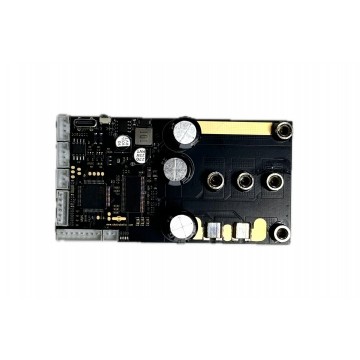
•The Hardware Solution: The VESC-LS 57V (14S) 300A VESC Motor Controller V4 at $59.00.
•Why It Beats Marketplace Clones: Priced lower than most 12S clones, this unit natively supports up to 14S lithium packs (58.8V peak) with 300A burst current. It provides full FOC Space-Vector modulation, phase current decoupling, and Hall/sensorless tracking, making it the most cost-effective single-axis inverter for 36V–52V commuter conversions and light mobile robotics.
2. The Under-$100 Dual-Motor Solution (Street Skateboards & Differential AMRs)
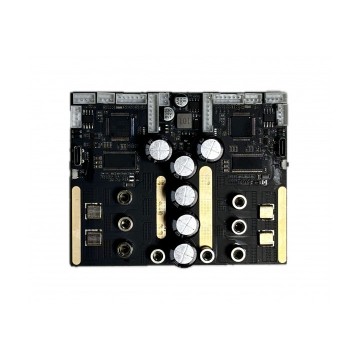
•The Hardware Solution: The Dual VESC-LS 57V (14S) 300A VESC Motor Controller at $99.00.
•The Economic Breakdown: Sourcing two separate budget single controllers costs at least $130–$160, plus the cost of external CAN jumper cables, dual power-splitting harnesses, and complex chassis grounding. The Dual VESC-LS packages two independent motor stages onto a single heatsink-backed board for $49.50 per motor axis. This architecture eliminates CAN ground loops and cuts assembly time in half for dual-motor street e-skates and dual-wheel differential autonomous mobile robots (AMRs).
3. The Under-$130 High-Voltage Platform (72V E-Bikes & Compact Light EVs)
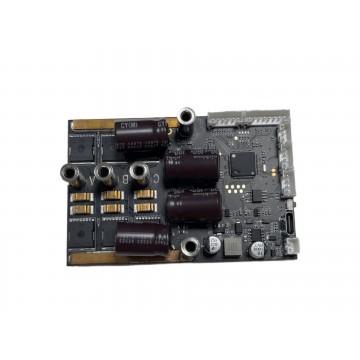
•The Hardware Solution: The VESC-S 90V (21S) 300A VESC Motor Controller V2 at $129.00.
•Why Voltage Headroom Matters: Attempting to run a 60V or 72V battery on standard 60V hobby controllers causes immediate overvoltage breakdown. The VESC-S delivers a 90V (21S) operating ceiling and 300A peak current in an ultra-compact footprint, allowing builders to deploy 72V high-efficiency battery packs without purchasing bulky industrial inverters.
4. The Under-$200 Vibration-Proof Platform (Self-Balancing Boards & Harsh Environments)
•The Hardware Solution: The X6 100V (22S) 315A VESC Motor Controller at $179.00, or the X6 150V (32S) 171A VESC at $199.00.
•The Integrated Value: Self-balancing Onewheel conversions demand high vibration resistance and native attitude sensing. The X6 series integrates a built-in 6-axis IMU, onboard Bluetooth, a DRV-less discrete EV-grade gate drive, and M5 screw terminals. Avoiding external IMU breakouts and accessory dongles saves $40 to $60 in parts, delivering a failure-resistant 100V–150V balance platform.
5. Engineering Best Practices: Maximizing the Lifespan of Value Hardware
Deploying cost-effective motor controllers near their continuous operating limits requires disciplined electrical and thermal integration:
•Mitigate Lead Wire Inductance: Keep DC battery lead lengths under 15 cm. If battery cabling must run longer, install a supplementary low-ESR electrolytic capacitor bank adjacent to the controller DC input terminals to clamp high-frequency voltage spikes generated during PWM switching: Delta_V = L_stray × (di/dt)
•Decouple Phase and Battery Current in VESC Tool:
•Set
Battery Current Maxto match the continuous discharge ceiling of your battery pack (protecting cell chemistry against thermal breakdown and low-voltage sag).•Set
Motor Current Maxsignificantly higher (typically 2x to 2.5x battery current) to deliver maximum low-speed hill-climbing torque without over-drawing the battery pack.•Enforce Direct Conductive Heatsinking: Avoid wrapping controllers in insulating foam or leaving them unbolted inside sealed enclosures. Apply high-conductivity thermal gap pads (thermal conductivity > 6.0 W/mK) between the controller baseplate and an aluminum vehicle chassis or heatsink cold plate.
•Drive Matched Magnetics: Driving motors with high internal phase resistance degrades inverter efficiency. Pairing controllers with factory-balanced ChatRobotic LandDrive Series Motors ensures accurate FOC flux-linkage observer tracking, lower ripple currents, and reduced stator heating.
6. Commercial Sourcing: Lowering BOM Costs Without Sacrificing Reliability
For OEMs, fleet operators, and robotics startups transitioning from single prototypes to volume commercial production, buying bare hobby ESCs introduces supply chain instability and unacceptable warranty claim rates.
ChatRobotic bridges the gap between budget constraints and industrial durability:
•Production-Scale PCBA Manufacturing: Turnkey fabrication of custom-geometry VESC-compatible boards in ISO 9001 and ISO 14001-certified facilities, delivering competitive volume discounts on heavy-copper, high-voltage boards.
•Custom CNC Enclosures & Thermal Integration: Direct machining of 6061-T6 aluminum heatsinks engineered to bolt into vehicle chassis geometry, providing IP67 ingress protection and structural thermal rejection.
•Factory-Calibrated Firmware Profiles: Controllers delivered pre-flashed with proprietary CANopen (CiA 402), ROS2, or analog throttle configurations, eliminating manual bench setup on your production line.
Frequently Asked Questions (FAQs)
Q1: Why is the $59 VESC-LS 57V more reliable than a generic $70 VESC 4.12 clone?
A: The VESC-LS 57V 300A V4 ($59) is engineered with a modern 14S (57V–58.8V) power architecture, heavy-copper PCB layout, and low-ESR components, providing real voltage headroom for 12S and 14S batteries. Legacy VESC 4.12 clones utilize outdated 60V MOSFETs and fragile DRV8301 gate-driver ICs that easily blow on 12S packs due to back-EMF spikes and trace overheating.
Q2: How does the Dual VESC-LS 57V achieve an effective cost of $49.50 per motor axis?
A: The Dual VESC-LS 57V 300A ($99) integrates two complete motor inverters and dual MCU stages onto a single circuit board sharing a unified heatsink and power input. By eliminating duplicate power wiring, separate PCB substrates, and external CAN transceivers, manufacturing costs are halved, allowing dual-drive setups at an effective cost of just $49.50 per channel.
Q3: What is the most cost-effective VESC controller for a 72V e-bike or light electric vehicle?
A: The VESC-S 90V (21S) 300A V2 ($129) is the most economical solution for 72V builds, providing 90V peak headroom and 300A burst phase current. For platforms requiring full aluminum casing protection and up to 125V (27S) headroom, the TRONIC 250R 125V 300A ($150) provides complete environmental sealing for high-speed use.
Need Custom High-Power Powertrain Engineering? Order production samples directly from our entry-level and high-value controller lineup:
•Under-$60 Single 14S Drive: VESC-LS 57V (14S) 300A VESC Motor Controller V4 ($59.00)
•Under-$100 Integrated Dual-Motor Drive: Dual VESC-LS 57V (14S) 300A VESC Motor Controller ($99.00)
•Under-$130 High-Voltage (21S) Platform: VESC-S 90V (21S) 300A VESC Motor Controller V2 ($129.00)
•Vibration-Proof 100V Balance Platform: X6 100V (22S) 315A VESC Motor Controller ($179.00)
•All-Weather 125V High-Speed Drive: TRONIC 250R 125V (27S) 300A VESC Motor Controller ($150.00)
Explore our full VESC (100A~3000A) Motor Controllers catalog or contact our power electronics team directly for custom 26S–32S+ power stages, CAD/STEP models, and volume OEM/ODM manufacturing: Contact ChatRobotic Engineering


{{ commentCount }} Comments