
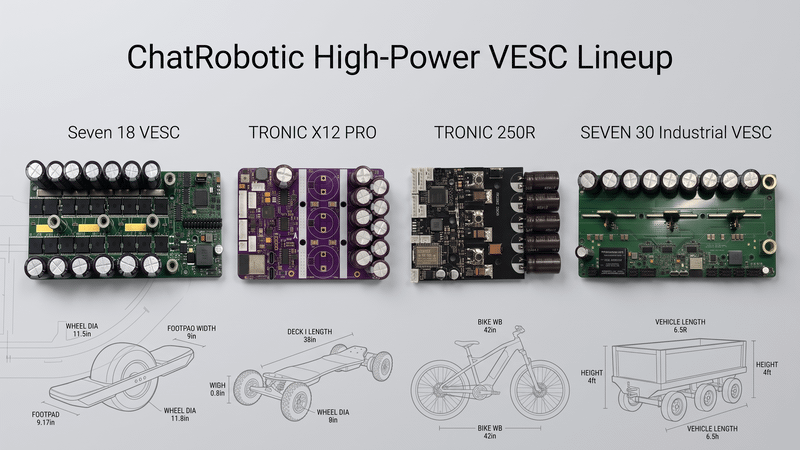
Quick Takeaway (TL;DR): Matching a VESC motor controller to an application depends on motion dynamics: self-balancing vehicles (Onewheel/EUC) require low-latency onboard IMUs and massive burst phase current (SEVEN 18 / TRONIC X12 PRO); high-performance e-skateboards require dual-node CAN synchronization (X12 PRO / SEVEN 18); e-bikes and urban scooters prioritize cost-effective FOC sine-wave control and regen (TRONIC 250R); industrial robotics/AGVs demand deterministic CAN-bus telemetry; and e-motorcycles require extreme 950A–1710A power stages (SEVEN 30 / TRONIC 1000 / TRONIC X54).
1. Application-Driven Motion Dynamics & Selection Criteria
Selecting the ideal Electronic Speed Controller (ESC) requires calculating the exact electromechanical stresses imposed by your vehicle or robotic platform. A single controller architecture cannot efficiently serve every duty cycle:
•Torque Generation (Phase Current Sizing): Torque (Nm) = K_t × I_phase Where K_t is the motor torque constant and I_phase is the controller's AC phase output. High-traction builds (mountainboards, Onewheels, towing AGVs) require high burst phase amperage to avoid low-speed stall or saturation.
•High-Speed Commutation (ERPM Ceiling): ERPM = Mechanical RPM × Motor Pole Pairs High-speed direct-drive actuators must operate within the 150,000 ERPM limit of the VESC microcontroller core to prevent observer loss-of-sync faults.
•Thermal Duty Cycles: Conduction Loss (W) = 3 × (I_rms)^2 × R_ds(on) Continuous uphill propulsion generates steady thermal buildup requiring structural chassis conduction, whereas light urban commuting relies primarily on passive thermal dissipation.
Powertrain Sizing Sequence:
•Motion Profile Analysis
•Self-Balancing Pitch/Roll Control -> Mandatory Integrated IMU + High Burst Headroom
•Dual/Quad Synchronized Traction -> Multi-Drop CAN Bus + Matched Current Stages
•High-Duty Continuous Automation -> Industrial FOC + Discrete Rugged Gate Drivers
•High-Voltage Traction (100V–140V) -> 32S Silicon Architecture + Liquid Cooling
For complete mathematical sizing of battery voltage headroom, phase vs. battery current conversion, and thermal dissipation, consult the complete 2026 VESC buyer's guide.
2. Deep-Dive Application Profiles & Hardware Matching
1. Onewheel & Self-Balancing Motion Systems
Self-balancing single-wheel platforms rely on continuous pitch and roll corrections computed at 500 Hz to 1 kHz. A sudden voltage sag or phase-current ceiling will cause a "nose-dive" failure.
•Engineering Requirements: Integrated 6-axis IMU, low internal latency, high burst phase current (>= 600A), and 5V-tolerant ADC foot-sensor inputs.
•Recommended Hardware:
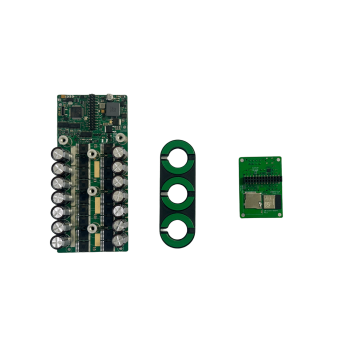
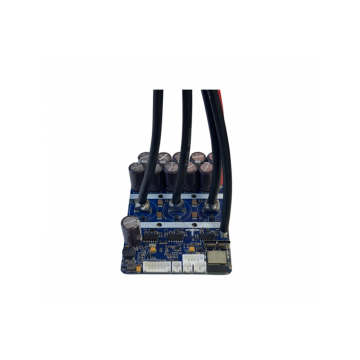
•Primary Choice: SEVEN 18 120V (26S) 993A / 150V (32S) 792A – The benchmark for maximum power density in compact single-wheel battery boxes.
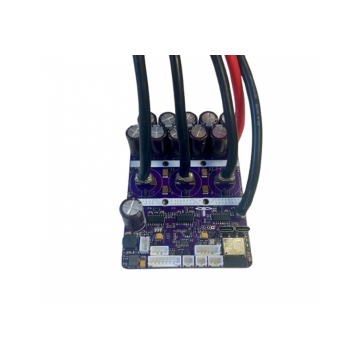
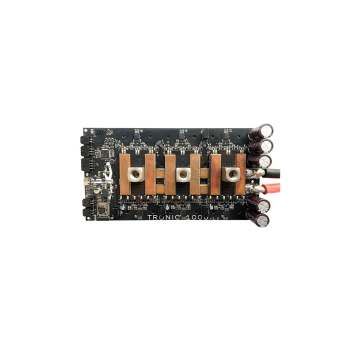
•Value Performance Choice: TRONIC X12 PRO 120V (26S) 662A / 150V (32S) 380A – Integrated IMU and integrated Bluetooth transceiver at a mid-tier price point.
•Build Architecture: Flash the ReFloat balance package in VESC Tool. Calibrate 6-axis gyro/accelerometer offsets on a flat surface. Follow the complete step-by-step configuration in our VESC Onewheel Upgrade and Customization Guide.
2. Electric Skateboards (E-Skate) & EUCs
Performance e-skateboards demand massive low-end torque for rapid acceleration and hill climbing, typically utilizing dual-motor or quad-motor outrunner configurations.
•Engineering Requirements: Compact profile to fit shallow under-deck enclosures, microsecond-latency CAN-bus synchronization, and robust regenerative braking.
•Recommended Hardware:
•Dual-Drive 26S Platforms: Dual TRONIC X12 PRO 120V (26S) (662A peak per channel).
•Ultra-Compact High-Current Builds: Dual SEVEN 18 120V (26S) (993A peak per channel).
•High-Voltage 32S Racing Boards: TRONIC X12 PRO 150V (32S) or SEVEN 18 150V (32S).
•Build Architecture: Connect two controllers via twisted-pair CAN lines (CAN_H, CAN_L, GND). Assign Master (ID: 0) and Slave (ID: 1). Implement dual-drive current limits following the VESC Electric Skateboard DIY Build Guide.
3. High-Efficiency E-Bikes & Commuter Scooters
Utility electric bicycles and urban commuter scooters prioritize smooth, silent Field-Oriented Control, programmable pedal-assist/throttle response, and reliable regenerative braking.
•Engineering Requirements: 10S–27S broad voltage support, discrete driver reliability, 5V-tolerant ADC Hall-throttle inputs, and budget efficiency.
•Recommended Hardware:
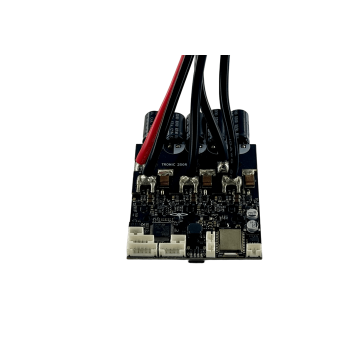
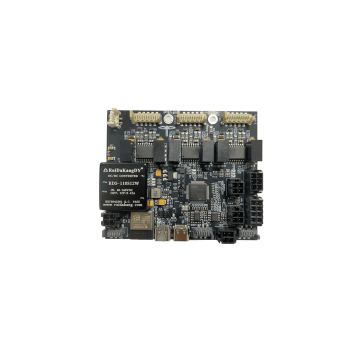
•Optimal Value Choice: TRONIC 250R 125V (27S) 300A – Discrete DRV-less architecture, 210A continuous capability with active cooling, starting from $150.
•High-Power E-Bike Conversions: TRONIC X12 PRO 120V (26S) for sustained 3 kW–10 kW hub or mid-drive setups.
•Build Architecture: Wire an analog thumb/twist throttle to the ADC pin. Configure input mapping with a 5% deadband and a 0.2-second ramp-up filter in VESC Tool.
4. Autonomous Mobile Robots (AMRs) & Industrial AGVs
Robotic platforms operating in logistics, agriculture, and inspection require deterministic communication, accurate low-speed position tracking, and heavy payload handling.
•Engineering Requirements: Isolated CAN communication, ROS/ROS2 driver compatibility, position-holding FOC control, and direct attitude monitoring.
•Recommended Hardware:
•Standard AGV Drive Nodes: TRONIC 250R – Low-cost, highly reliable CAN node for warehouse rovers.
•Heavy-Duty High-Torque Actuation: SEVEN 18 120V (26S) 993A – Massive breakout torque for rough-terrain UGVs.
•Build Architecture: Interface controllers with an onboard companion computer (NVIDIA Jetson, Raspberry Pi) running VESC ROS packages over CAN or UART.
5. Electric Motorcycles, Marine & Extreme-Duty Propulsion
High-voltage platforms (100V–140V+) pulling four-figure phase currents require extreme power stages and automotive-grade silicon arrays.
•Engineering Requirements: 950A–1710A phase current handling, active liquid cooling cold-plate integration, and high-voltage regenerative spike suppression.
•Recommended Hardware:
•Build Architecture: Integrate multi-pass aluminum water-cooling blocks and direct-couple to high-torque PMSM traction motors.
3. Comprehensive Application-to-Hardware Benchmark
| Application Sector | Primary Controller Choice | Secondary Controller Choice | Key Electrical Metric | Direct Product Link |
| Onewheel & Self-Balancing | SEVEN 18 120V (26S) / 150V (32S) | TRONIC X12 PRO 120V (26S) / 150V (32S) | Built-in IMU + 993A Peak | SEVEN 18 Product Page |
| Dual E-Skateboard (26S) | TRONIC X12 PRO 120V (26S) | SEVEN 18 120V (26S) | 662A Peak + CAN Multi-Drop | X12 PRO 120V (26S) Product Page |
| High-Voltage PEV (32S) | TRONIC X12 PRO 150V (32S) | SEVEN 18 150V (32S) | 134.4V Pack Rail (150V MOS) | X12 PRO 150V (32S) Product Page |
| Commuter E-Bikes & Scooters | TRONIC 250R 125V (27S) 300A | TRONIC X12 PRO 120V (26S) | 210A Cont. + DRV-Less Layout | TRONIC 250R Product Page |
| Robotics, AGVs & AMRs | TRONIC 250R (Budget) | SEVEN 18 (High Torque) | Isolated CAN + IMU Tracking | TRONIC 250R Product Page |
| E-Motorcycles & Industrial | SEVEN 30 120V (26S) 1655A | TRONIC X54 150V (32S) 1710A | 950A–1710A Liquid Cooled | SEVEN 30 Product Page |
In-Depth Controller Reviews & Sibling Comparisons
•Read the individual deep dive: SEVEN 18 VESC Review, Specs & Build Guide.
•Compare voltage boundaries: TRONIC X12 PRO 26S vs 32S Review.
•Explore entry-level engineering: TRONIC 250R 125V (27S) 300A VESC Review.
•Review the 3-way benchmark: SEVEN 18 vs. TRONIC X12 PRO vs. TRONIC 250R Comparison.
•Browse the complete ChatRobotic VESC Motor Controllers Catalog.
4. Field Commissioning & Safety Workflows by Application
Commissioning Protocols:
•Step 1: Pre-charge Verification & Initial Bench Supply Power-Up (1.0A limit)
•Step 2: Automated FOC Wizard Detection (R, L, Flux Linkage Lambda)
•Step 3: Application-Specific Sensor Configuration:
•Onewheel: IMU 6-Axis Alignment & ReFloat Pitch/Roll PID Setup
•Dual E-Skate: Master/Slave CAN ID Assignment & Remote Pairing
•E-Bike: ADC Throttle Calibration with 5% Deadband
•AGV: CAN Baud Rate Mapping (500k/1M) & ROS Telemetry Stream
•Step 4: Thermal Rollback Limit Setup (75°C Start / 95°C Hard Cutoff)
Application-Specific Commissioning Pitfalls
1. Onewheel IMU Misalignment: Mounting the controller off-axis without software roll/pitch offset compensation will cause erratic balance oscillations. Always calibrate level offsets on a flat surface.
2. Dual-VESC Ground Loops: When connecting two controllers over CAN bus, avoid looping high-current power ground returns through thin signal ground leads.
3. E-Bike Throttle Noise: Long, unshielded ADC throttle wires running alongside phase cables can induce voltage spikes, causing unexpected throttle jumps. Use twisted, shielded wiring.
4. Thermal Saturation in Enclosed Decks: High-power controllers operating above 200A continuous must be mounted flat against an external aluminum heat sink using high-conductivity gap pads (conductivity >= 6.0 W/m·K).
5. System Integration & ChatRobotic Turnkey OEM Capabilities
ChatRobotic bridges the gap between open-source firmware flexibility and vehicle-grade electronic manufacturing:
•Complete Powertrain Ecosystem: Direct mechanical and electrical compatibility with ChatRobotic LandDrive (traction/direct-drive), AirDrive (aerial propulsion), and SeaDrive (marine thrusters).
•NDAA-Compliant Electronic Manufacturing: Hardware architectures built with verified, non-restricted semiconductor supply chains, suitable for commercial robotics, aerospace, and defense applications.
•Custom Firmware & Communication Stacks: Tailored VESC firmware forks featuring application-specific CAN message profiles, custom throttle ramp equations, and hardware interlocks.
•Turnkey PCBA & CNC Enclosure Services: ISO9001/14001 certified rapid prototyping, high-density SMT assembly, and custom billet aluminum enclosure milling.
Frequently Asked Questions (FAQs)
Q1: Do standard e-bikes require a VESC with a built-in IMU?
A: No. An IMU (Inertial Measurement Unit) is specifically required for self-balancing personal electric vehicles such as Onewheels and EUCs. Standard e-bikes, kick scooters, and conventional dual-drive skateboards do not require IMU feedback for motor commutation.
Q2: What is the best VESC controller for a dual-motor electric skateboard?
A: The TRONIC X12 PRO is the leading choice for dual-motor e-skateboards. Its slim 95×73×22 mm form factor allows two units to mount side-by-side in shallow battery compartments, delivering up to 662A peak phase current per motor with synchronized CAN communication.
Q3: Can one VESC controller model be repurposed across different vehicle types?
A: Yes. Because VESC firmware is fully programmable, a single controller (such as the TRONIC X12 PRO or SEVEN 18) can drive a self-balancing Onewheel, an e-bike, or an AGV by simply reconfiguring motor parameters, throttle input types (ADC, PPM, CAN, UART), and application settings in VESC Tool.
Q4: Which controller is recommended for 32S (134.4V) battery systems?
A: For 32S battery architectures, select either the TRONIC X12 PRO 150V (32S), SEVEN 18 150V (32S), SEVEN 30 150V (32S) 950A, or TRONIC X54. These units feature 150V-rated MOSFETs to maintain a safety margin above the 134.4V peak battery rail.
Q5: How do ChatRobotic VESC controllers integrate with ROS/ROS2 for autonomous robotics?
A: ChatRobotic VESC controllers communicate with onboard companion computers (such as NVIDIA Jetson or Raspberry Pi) via UART or CAN bus. Standard open-source VESC ROS/ROS2 packages allow roboticists to command real-time wheel velocities, extract current and ERPM telemetry, and monitor chassis attitude directly from the onboard IMU.
Need Custom High-Power Powertrain Engineering?
Explore the complete ChatRobotic VESC Motor Controllers catalog or get in touch with our engineering and hardware manufacturing team directly for custom CAD/STEP models, specialized 26S–32S+ power stages, and volume OEM/ODM inquiries: Contact ChatRobotic Engineering


{{ commentCount }} Comments