
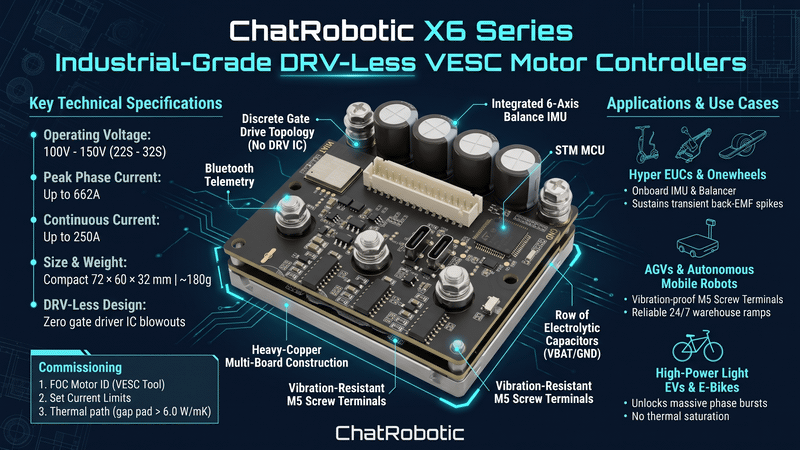
Quick Takeaway (TL;DR): The ChatRobotic X6 Series represents an industrial-grade, DRV-less VESC motor controller architecture engineered for 100V to 150V (22S–32S) platforms. Delivering continuous currents up to 250A and transient phase bursts up to 662A, the X6 series eliminates gate-driver IC blowouts, integrates an onboard 6-axis balance IMU, and provides heavy-duty M5 screw terminations for high-reliability mobile robotics, hyper EUCs, and performance light electric vehicles (LEVs).
1. High-Voltage Powertrain Demands: Why DRV-Less VESC Inverters Dominate Modern Builds
In high-power electric powertrains operating above 60V, conventional open-source motor controllers frequently experience catastrophic field failures. The primary failure mode stems from integrated gate-driver ICs (such as the legacy DRV8301/DRV8302). Under rapid regenerative braking or high current slew rates (di/dt), high-inductance battery leads generate transient voltage spikes: V_spike = V_bus + [L_bus × (di/dt)]
When these transients exceed the absolute maximum ratings of the charge pump or internal bootstrap diodes, the driver IC punctures, inducing cross-conduction (shoot-through) across the power MOSFETs.
Modern industrial platforms—such as 72V–96V e-motorcycles, 100V–134V Electric Unicycles (EUCs), and 48V–96V Automated Guided Vehicles (AGVs)—demand operating ceilings between 100V and 150V. The ChatRobotic X6 Series eliminates integrated gate-driver ICs entirely, deploying a discrete, automotive-grade gate-drive stage paired with heavy-copper busbars to deliver resilient Field-Oriented Control (FOC) under abusive mechanical and electrical duty cycles.
2. X6 Hardware Architecture: EV-Grade Power Stage & Integrated Sensing
The X6 architecture is engineered specifically to resolve the thermal, vibrational, and electrical stress points encountered in heavy-duty mobility and robotics.
Discrete DRV-Less Gate Drive Topology
By replacing fragile all-in-one driver ICs with discrete transistor pairs, pulse transformers, and dedicated high-side charge pumps, the X6 inverter stage isolates the logic microcontroller from DC bus ground bounce. This discrete topology withstands severe inductive back-EMF spikes during sudden wheel lockup or emergency regenerative deceleration, ensuring gate voltage (V_gs) remains clamped below breakdown thresholds.
Heavy-Copper Multi-Board Construction
•3x to 4x DC-Link Copper Weight: The X6 utilizes a dual-board stacked configuration featuring extra-heavy copper planes dedicated to DC-link distribution. This minimizes I^2*R resistive heating: Conduction Loss (W) = 3 × I_rms^2 × R_ds(on)
•M5 Solid Screw Terminals: Fragile soldered lead wires and loose bullet connectors are replaced with five M5 threaded terminal blocks, providing vibration-proof mechanical torque and low contact resistance for phase lines (U, V, W) and DC battery inputs.
•Compact High-Density Packaging: Measuring 72 × 60 × 32 mm and weighing approximately 180g (base configuration), the X6 packages up to 150V and 662A peak capacity into an envelope compatible with narrow chassis side fairings and tight battery compartments.
Integrated 6-Axis Balance IMU & Wireless Telemetry
Unlike general-purpose inverters requiring external sensor breakouts, the X6 features an onboard 6-axis IMU chip connected directly to the primary MCU bus. This eliminates external SPI/I2C wiring harnesses that can suffer vibrational fatigue in self-balancing vehicles. An onboard Bluetooth transceiver provides out-of-the-box telemetry pairing with mobile VESC Tool dashboards.
3. ChatRobotic X6 Product Lineup: Technical Benchmark & Selection Matrix
The ChatRobotic X6 series spans three distinct voltage classes (100V, 120V, and 150V) and multiple phase current tiers to match exact powertrain requirements:
| Controller Model | Max Voltage (S Rating) | Peak Phase Current | Continuous Current | Substrate & MOSFET Class | Unit Price |
| X6 100V (22S) 315A VESC | 100V (22S Li-ion) | 315A peak | 120A continuous | Heavy Copper, Discrete Gate | $179.00 |
| X6 100V (22S) 630A VESC | 100V (22S Li-ion) | 630A peak | 220A continuous | Dual-FET Array, Low R_ds(on) | $229.00 |
| X6 120V (26S) 331A VESC | 120V (26S Li-ion) | 331A peak | 130A continuous | Heavy Copper, Discrete Gate | $199.00 |
| X6 120V (26S) 662A VESC | 120V (26S Li-ion) | 662A peak | 250A continuous | Paralleled TO-247 Array | $299.00 |
| X6 150V (32S) 171A VESC | 150V (32S Li-ion) | 171A peak (10s) | 120A continuous | 6x TO-247 (IRFP4568PBF) | $199.00 |
| X6 150V (32S) 263A VESC | 150V (32S Li-ion) | 263A peak | 140A continuous | High-Voltage Discrete Array | $239.00 |
| X6 150V (32S) 316A VESC | 150V (32S Li-ion) | 316A peak | 160A continuous | High-Voltage Discrete Array | $269.00 |
| X6 150V (32S) 526A VESC | 150V (32S Li-ion) | 526A peak | 220A continuous | Ultra-Duty 150V Power Stage | $339.00 |
4. Application Engineering: Matching the X6 Series to Specific Powertrain Demands
Selecting an X6 model requires aligning battery nominal voltage, rotor inertia, and peak duty-cycle demands.
1. Self-Balancing Systems: Onewheel "Vescification" & Hyper EUCs
Single-wheel balancing platforms cannot tolerate controller cutouts. An inverter must sustain immense transient current to counter balance disturbances:
•Onewheel 18S–20S Conversions: The X6 150V 171A VESC and X6 120V 331A VESC are the industry benchmarks for single-wheel builds. The integrated IMU eliminates sensor wiring, while the 120V–150V breakdown rating prevents back-EMF spikes from triggering overvoltage cutouts during curb drops.
•100V–134V Flagship EUCs (Begode Master, Veteran Lynx/Patton): Extreme trail and street EUCs demand high sustained current alongside 150V headroom. The X6 150V 316A VESC and the high-output X6 150V 526A VESC provide the burst phase current required to prevent high-speed cutouts during aggressive acceleration.
2. High-Power E-Bikes, Mid-Drives & Sur-Ron/Talaria Upgrades
Upgrading 60V–72V e-motos and heavy mid-drives requires immense low-end phase current for wheelie torque without thermal saturation:
•72V High-Output Sur-Ron/Talaria Conversions: Deploying the X6 100V 630A VESC or the X6 120V 662A VESC delivers over 600A of phase current. This enables riders to unlock 15 kW to 20 kW mechanical bursts from aftermarket motors while maintaining low operating temperatures via heavy-copper current planes.
•Mid-Drive Upgrades (Bafang Ultra M620, CYC X1 Pro): The X6 100V 315A VESC provides smooth FOC sinusoidal commutation, eliminating gear-stripping torque spikes common to trapezoidal controllers.
3. Industrial Autonomous Mobile Robots (AMRs) & Heavy AGVs
Factory logistics robots operate on continuous, 24/7 duty cycles with high-inertia payloads:
•48V–80V Warehouse Traction Drives: The X6 100V 630A VESC and X6 120V 331A VESC provide robust CAN-bus networking and high starting torque to navigate warehouse ramps with payloads from 1,000 kg to 3,000 kg. M5 screw terminals resist continuous mechanical shock.
•Direct-Drive Actuation: Pairing X6 inverters with ChatRobotic LandDrive Series Motors ensures pre-calibrated FOC parameters, matched stator inductance, and minimal cogging torque.
5. System Commissioning, Thermal Management & B2B OEM Customization
Deploying the X6 Series into commercial production fleets requires rigorous electrical integration and thermal path design.
Thermal Dissipation Engineering
While the X6 features heavy copper planes, high continuous current draws necessitate conductive heatsinking:
•Apply high-performance thermal gap pads (thermal conductivity > 6.0 W/mK) between the controller baseplate and the vehicle chassis cold plate.
•Ensure uniform mounting compression using M3/M4 mounting standoffs to prevent localized hot spots across the MOSFET array.
•For unventilated chassis compartments, pair high-current models (526A / 662A) with external finned aluminum heatsinks exposed to ambient airflow.
Software Configuration Workflow in VESC Tool
1. FOC Motor Identification: Connect via USB-C or onboard Bluetooth. Run the motor wizard to log phase resistance (R), phase inductance (L), and flux linkage (lambda).
2. Current Limit Thresholding: Decouple phase current from battery current. Set
Motor Current Maxaccording to thermal dissipation capacity, and configureBattery Current Maxto match pack continuous discharge specifications.3. Balance App Setup (for Self-Balancing Applications): Navigate to
App Settings -> IMUand select the onboard IMU chip. Calibrate pitch and roll zero-offsets on a flat surface, settingPitch K_pandK_dgains alongside an 80 Hz low-pass filter to reject vibration noise.
Turnkey OEM/ODM Manufacturing Capabilities
ChatRobotic provides end-to-end engineering support for industrial vehicle manufacturers, robotics startups, and fleet operators:
•Custom Form-Factor Integration: Tailored PCBA layouts, custom wire harnesses, and proprietary CNC-machined heatsink enclosures.
•Firmware Customization: Pre-configured CANopen (CiA 402), UAVCAN, or custom UART telemetry profiles tailored directly to customer motion controllers.
•Compliance & Scale: All X6 controllers are manufactured in ISO 9001 and ISO 14001-certified production facilities, offering full trace testing, selective conformal coating, and NDAA-compliant component sourcing.
Frequently Asked Questions (FAQs)
Q1: What makes the X6 series DRV-less architecture superior to traditional DRV8301-based VESC controllers?
A: Traditional VESC designs utilize integrated gate-driver ICs (such as the DRV8301) that house the buck converter, current-sense amplifiers, and gate drivers on a single silicon die. High voltage spikes or inductive back-EMF transients easily puncture these chips, destroying the controller. The X6 series uses an EV-grade discrete gate driver circuit with high breakdown margins, completely eliminating single-point IC failures and ensuring reliable operation under heavy regenerative braking.
Q2: Which X6 controller is optimal for a 20S Onewheel or 24S EUC conversion?
A: For a 20S (84V) Onewheel conversion, the X6 150V 171A VESC or X6 120V 331A VESC offers the best combination of compact size (72x60x32 mm), onboard IMU, and 120V–150V breakdown protection. For a 24S (100.8V) or 30S (126V) EUC conversion, deploy the X6 150V 316A VESC or X6 150V 526A VESC to secure massive burst phase current for cutout prevention.
Q3: Can ChatRobotic provide custom firmware, enclosures, and harness integration for volume commercial fleets?
A: Yes. ChatRobotic delivers full-stack OEM/ODM manufacturing. We supply custom-geometry PCBAs, CNC-machined IP67 aluminum chassis, pre-flashed custom firmware with automated CANopen or ROS2 integration, and custom wiring harnesses manufactured in our ISO 9001-certified facilities for volume commercial deployments.
Need Custom High-Power Powertrain Engineering? Explore the complete ChatRobotic X6 series and featured high-power motor drivers:
•X6 100V (22S) 315A VESC Motor Controller ($179.00)
•X6 100V (22S) 630A VESC Motor Controller ($229.00)
•X6 120V (26S) 331A VESC Motor Controller ($199.00)
•X6 120V (26S) 662A VESC Motor Controller ($299.00)
•X6 150V (32S) 171A VESC Motor Controller ($199.00)
•X6 150V (32S) 263A VESC Motor Controller ($239.00)
•X6 150V (32S) 316A VESC Motor Controller ($269.00)
•X6 150V (32S) 526A VESC Motor Controller ($339.00)
Explore our full VESC (100A~3000A) Motor Controllers catalog or contact our power electronics team directly for custom 26S–32S+ power stages, CAD/STEP models, and volume OEM/ODM manufacturing: Contact ChatRobotic Engineering


{{ commentCount }} Comments