
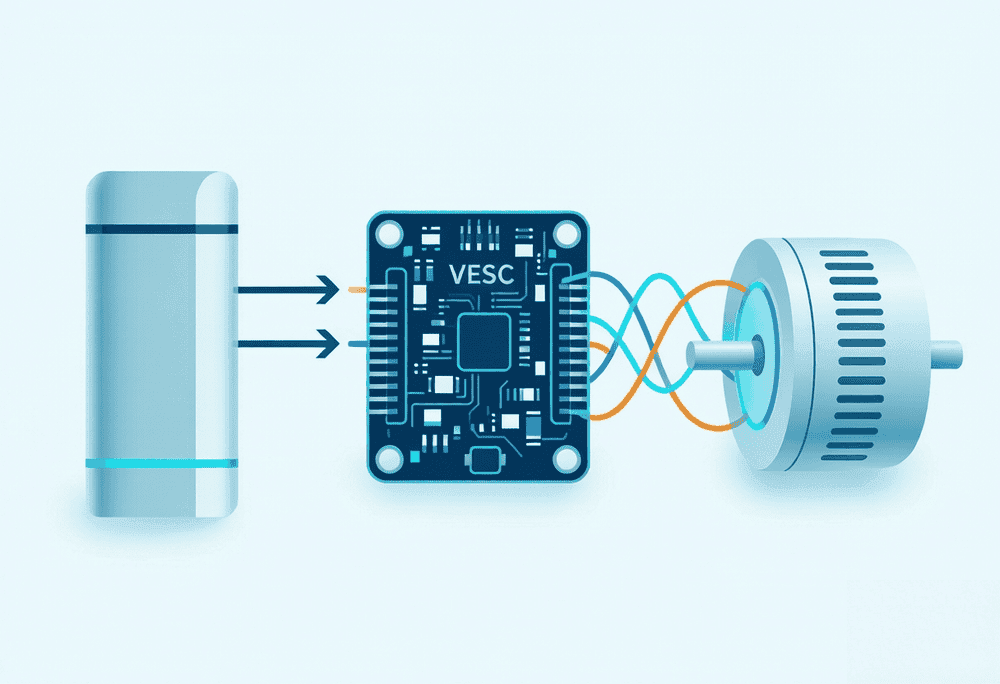
If you've ever opened VESC Tool, looked at "Battery Current Max" and "Motor Current Max," and wondered whether they're the same number — you're not alone. Mixing these two up is one of the most common VESC troubleshooting headaches we see, and getting it wrong can leave your build weak, trip your BMS, or throw phantom over-current faults. This guide explains the difference, gives you the conversion, and shows why it matters when something goes wrong.
What Is Battery Current?
Battery current — also called DC current or bus current — is the current flowing between your battery pack and the VESC. It's what your pack, BMS, fuses, and wiring actually carry on the DC side. When your BMS "trips under load" or your fuse blows, this is the current that did it.
What Is Phase Current?
Phase current — also called motor current or AC current — is the current flowing through the motor's three windings. This is the current that produces torque. In VESC Tool it's the value behind "Motor Current Max." The controller regulates this directly in FOC; it's what makes the motor spin.
Why the Two Numbers Are Never the Same
The VESC chops the steady DC bus into three-phase AC to drive the motor. The battery only supplies the net power drawn, while the motor windings carry the instantaneous AC that creates the rotating magnetic field. Because of duty cycle and the motor's back-EMF, the phase current is almost always higher than the battery current at normal operating points. The exact ratio shifts with RPM, duty cycle, and inductance — but for practical sizing there's a reliable rule of thumb.
The Conversion Rule of Thumb (with a Real Example)
At ChatRobotic we rate our controllers by phase current — that's the number on our product pages. For example, the VESC-S 90V/210A controller is rated by its 210A phase current, not its battery current. The relationship we use on the bench:
• Phase current is roughly 1.3× to 1.4× the battery current.
• Equivalently, battery current is about 70% of phase current.
You can also estimate straight from power. Battery current ≈ Power ÷ Pack voltage (DC). A customer recently asked us: an 80 kW build on a 30S pack — what current is that? A 30S pack at full charge is about 126 V, so 80,000 W ÷ 126 V ≈ 634 A battery current. Apply the rule of thumb and the phase current lands around 824–888 A — and that's the number you'd match against a controller's phase-current rating.
Why This Matters for VESC Troubleshooting
This is where the theory turns into real, fixable problems:
• Gutless throttle / limited power. If you set "Motor Current Max" thinking it's your battery limit, you may cap the phase current too low and the motor feels weak no matter how hard you push.
• BMS or fuse trips under load. Sizing your pack off the phase number makes you over-spec (wasteful); sizing it off a misunderstood DC number makes you under-spec, and the BMS cuts out exactly when you need power.
• ABS_OVER_CURRENT faults. This fault watches the phase current. If you don't realize your controller's rating is a phase rating, you'll set the limit wrong and trip it during hard acceleration.
• Wrong controller choice. Our site lists phase current, so compare it against your pack's battery continuous rating using the 0.7× conversion — not against the phase number directly.
Quick Reference
• Battery current = DC bus current (your pack, BMS, and fuses see this).
• Phase current = motor winding current (the VESC controls this; it's "Motor Current Max" in VESC Tool).
• Phase ≈ 1.3–1.4 × battery; battery ≈ 0.7 × phase.
• Estimate battery current as Power ÷ Pack voltage.
• ChatRobotic product specs are phase current — convert before matching your pack.
For the full fault-code reference and fixes for every common error, see our Ultimate VESC Troubleshooting Guide.
ChatRobotic designs and supports VESC-based controllers for e-skate, unicycle, e-moto and robotics builders.


{{ commentCount }} Comments