
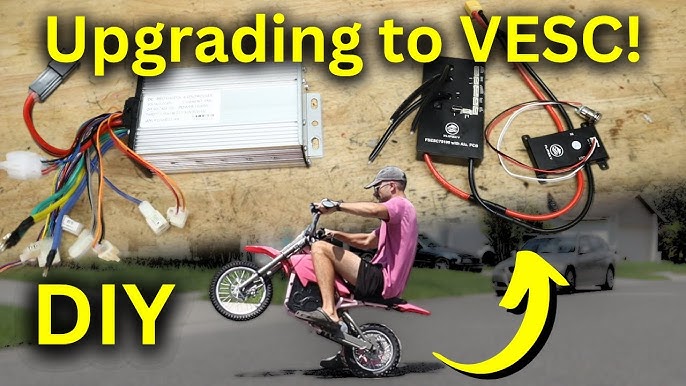
Most factory e-bike controllers lock you into fixed performance parameters. The VESC (Vedder Electronic Speed Controller) changes everything. Built on open-source firmware, it puts you in complete control of your motor's behavior — from regenerative braking that extends your range to Field-Oriented Control (FOC) that delivers whisper-quiet, buttery-smooth power delivery. Here's how to unlock your e-bike's full potential.
Why Replace Your Factory Controller?
Proprietary e-bike controllers are black boxes. You get what the manufacturer decided you need — no more, no less. VESC is different. It's open-source firmware that runs on a wide range of hardware, giving you access to every parameter that affects how your motor performs.
The two standout features that make VESC a game-changer for e-bikes are regenerative braking and FOC smoothness. Together, they transform the riding experience while extending your battery range and reducing mechanical brake wear.
Regenerative Braking: Turn Stopping into Charging
Regenerative braking captures kinetic energy that would otherwise be wasted as heat and pumps it back into your battery. Skilled riders can recover 10–25% of energy on hilly routes through well-tuned regen.
How to Set It Up
VESC separates braking into two independent parameters:
• Motor Current Max Brake — how much current the motor can draw during braking
• Battery Current Max Regen — how much current flows back into your battery
It's fairly common for the Battery Current Max Regen value to be lower than the Battery Current Max value. This protects your battery from excessive charge current.
Control Options
You have multiple ways to activate regenerative braking:
• Variable regen via thumb throttle — mount a second thumb throttle on your brake lever for proportional braking force
• ADC throttle with braking — configure your throttle so releasing it engages regen
• Brake lever sensor — activate regen before your mechanical brakes engage
One builder achieved variable pedal assist with regen braking using a Flipsky 75100 Pro V2, a 4-wire PAS sensor, and a thumb throttle mounted in the rear brake lever. The setup allows regen to engage before the disc brakes, extending pad life while recovering energy.
⚠️ Warning: When using the motor as a generator for regenerative braking, your battery will be charged. Stop using regen if your battery is full — overcharging can damage your pack.
FOC Smoothness: The Silent Revolution
Field-Oriented Control (FOC) is the primary motor control method in VESC firmware, treating motor currents as independent vectors for optimal efficiency and precision. The result? Motors run silently and smoothly even at very low speeds.
Why FOC Matters for E-Bikes
• Whisper-quiet operation — no more buzzing or whining from your motor
• Buttery smooth starts — no jerky engagement from a standstill
• 3–8% better efficiency than square wave controllers — measurable range gain on every commute
• Superior low-speed control — precise torque delivery for tricky terrain
Initial FOC Configuration
Start with the Setup Motors FOC wizard in VESC Tool. This automatically detects motor parameters including resistance, inductance, and flux linkage.
For firmware version 6.05 and later, apply these critical settings:
• Motor Settings → FOC → Advanced → Speed Tracker Position Source: Corrected Position
• Motor Settings → FOC → Advanced → Short Low-Side FETs on Zero Duty: Enabled (this enables stronger brakes at standstill)
Under Motor Cfg → FOC → Advanced, set Observer Type to FOC_OBSERVER_ORTEGA_ORIGINAL and run the Motor Setup Wizard. Ortega Lambda-Comp is also a great option to try.
Field Weakening: More Speed When You Need It
Field weakening extends your top speed by reducing motor flux at high RPMs. It's been in VESC firmware since 2021 and has been used by e-bike builders for years without issues.
Starting configuration:
• FW Max Current: 30A (a little more may work, but be mindful of your BMS cutoffs)
• FW Duty Start: 65% (some go as low as 50%)
• Ramp Time: 500ms (helps avoid abrupt transitions)
• Max Duty Cycle: 95–96%
Field weakening doesn't sacrifice efficiency — the additional current goes into speed rather than being wasted as heat in the motor windings. One builder achieved about 30% more speed with field weakening enabled.
Fine-Tuning Your Ride
Observer Gain
The Observer Gain value influences the precision of motor control and often requires fine-tuning for optimal performance. A common approach is to reduce the detected observer gain by roughly half.
Current Limits
Set your Battery Current Max according to your battery's capabilities. For a 14S 25Ah pack, a builder successfully used regen at -25A with Battery Current Max at 45A. Conservative limits protect your hardware while you dial in the perfect feel.
Variable Regen Tuning
For proportional regen control, configure your ADC input as "Current No Reverse Brake ADC2". This gives you variable braking force proportional to how far you pull the lever — from gentle deceleration to strong regenerative braking.
Getting Started
1. Choose your VESC hardware — Flipsky, MakerX, Spintend, and Trampa all offer VESC-based controllers suitable for e-bike voltages (typically 12S–20S)
2. Install VESC Tool — available for Windows, Mac, Linux, iOS, and Android
3. Connect and configure — run the FOC motor wizard, apply the recommended firmware 6.05+ settings, and tune your regen parameters
4. Test thoroughly — hand-test first with the wheel off the ground, then take a careful test ride
5. Iterate — adjust regen strength, field weakening, and throttle response to match your riding style
The Verdict
VESC transforms an e-bike from a fixed-function machine into a fully customizable riding experience. Regenerative braking extends your range and reduces brake wear. FOC delivers silent, smooth power that makes every ride feel premium. And the open-source ecosystem means you're never locked in — you can tweak, upgrade, and evolve your setup as your needs change.
Whether you're building from scratch or upgrading an existing bike, VESC is the controller that grows with you.


{{ commentCount }} Comments