
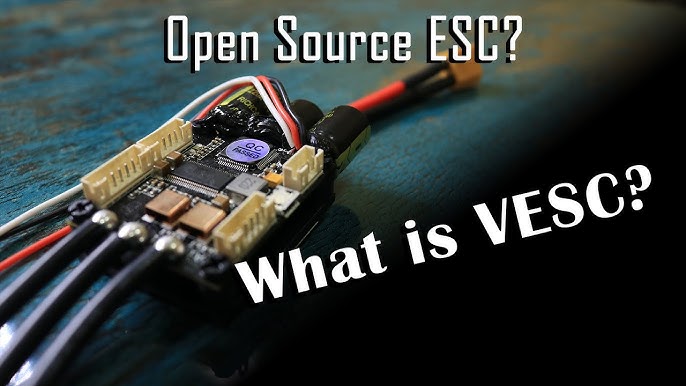
The VESC (Vedder Electronic Speed Controller) ecosystem has evolved far beyond its electric skateboard origins. Today, VESC motor controllers power everything from 1/10th-scale autonomous race cars to heavy-duty agricultural robots and research-grade humanoid platforms. With its open-source firmware, robust communication protocols, and seamless ROS integration, VESC has become a compelling choice for robotics applications ranging from AGVs to humanoids.
Why VESC for Robotics?
Open Architecture, Full Control
Unlike proprietary motor controllers that lock you into closed ecosystems, VESC gives developers complete access to the firmware. This means you can fine-tune every aspect of motor control—from Field-Oriented Control (FOC) parameters to custom control algorithms. The VESC ecosystem invites developers to look under the hood and understand their systems from the ground up, enabling possibilities that are difficult or impossible with closed-source alternatives.
ROS and ROS2 Integration
Perhaps VESC's greatest strength for robotics is its mature ROS ecosystem. The VESC ROS integration provides a layered architecture that abstracts low-level VESC serial protocols into standard ROS interfaces. This system supports:
• Direct motor control with real-time commands for speed (ERPM), current, and braking
• Sensor feedback including RPM, current, voltage, and temperature telemetry
• Vehicle control abstractions for Ackermann steering, differential drive, and odometry generation
• Standard ROS messages using common types like geometry_msgs and nav_msgs
For ROS2 users, the F1TENTH driver stack enables seamless communication between VESC hardware and the ROS2 framework. The vesc_ackermann package translates high-level navigation commands into low-level motor control signals, allowing robotics applications to treat VESC-controlled vehicles as standard ROS-compatible platforms
Scalable from Watts to Kilowatts
The VESC environment addresses engineering challenges on a broad scale—from miniature multicopters drawing tens of watts to electric passenger planes drawing hundreds of kilowatts. This scalability makes VESC suitable for everything from small research robots to heavy-duty industrial platforms.
VESC in Action: Real-World Robotics Applications
Autonomous Vehicles and AGVs
F1TENTH Autonomous Racing – The F1TENTH competition is perhaps the most prominent showcase of VESC in robotics. Teams build 1/10th-scale autonomous race cars equipped with NVIDIA Jetson Orin Nano for onboard computation and VESC MK6 controllers for precise motor control. The VESC ROS ecosystem was specifically designed with F1TENTH in mind, providing Ackermann steering abstractions and odometry generation.
IGVC Autonomous Ground Vehicles – Student teams competing in the Intelligent Ground Vehicle Competition frequently rely on VESC controllers for their autonomous vehicles. The VESC's robust design and open communication protocol make it ideal for outdoor navigation in complex environments.
Heavy-Duty Agricultural Robots – Community members have built >100kg farming robots using dual VESC controllers for skid-steering and tank-style drive. These applications demonstrate VESC's ability to handle substantial loads while maintaining precise control.
Research and Humanoid Platforms
The VESC Labs team includes embedded engineers with expertise in robotics, and the community has actively explored VESC's potential for humanoid and legged robots. Open-source research-grade humanoid platforms are increasingly adopting VESC-based architectures for their motor control needs.
Robotic Arms and Manipulators – Developers have used VESC controllers for powerful robotic arm projects, pairing 3kW BLDC motors with harmonic reductions and FOC configuration. The VESC's support for encoders, hall sensors, and sensorless operation makes it versatile for different actuation requirements.
Tactile Robotics – Research projects have integrated mini VESC controllers with tactile sensing systems for robotic traversal in complex environments, demonstrating VESC's suitability for advanced, sensor-rich robotics applications.
Combat Robotics and Specialized Platforms
For combat robotics applications, VESC is recognized as the most powerful ESC firmware option for advanced combat robots. Its combination of high current handling, regenerative braking, and deep configurability gives builders a competitive edge in demanding environments.
Key Technical Advantages for Robotics
Multi-VESC Coordination
VESC's CAN bus support enables seamless coordination of multiple controllers in complex robotic systems. Developers have successfully built four-wheeled differential drive robots using four VESCs with master-slave configurations, and three-wheeled driving robots with all controllers wired over CAN bus. This capability is essential for robots requiring multiple degrees of freedom or sophisticated drive systems.
Flexible Control Interfaces
VESC supports multiple control inputs including UART, CAN, PPM, and ADC. For robotics applications, this means you can interface with VESC using your preferred communication method—whether it's a microcontroller over UART, a high-level computer over CAN, or a direct PWM signal.
Comprehensive Telemetry
Real-time access to motor telemetry—including RPM, current, voltage, and temperature—enables sophisticated control algorithms and condition monitoring. This data is critical for autonomous systems that need to make decisions based on vehicle state.
Safety and Fault Protection
VESC controllers include overcurrent protection, thermal management, and comprehensive fault detection. These safety features are essential for robotics applications where hardware failures could have serious consequences.
VESC vs. Other Robotics Controllers
While ODrive excels in precision positioning for applications like robotic arms, VESC offers a different value proposition for robotics:
• Dynamic Response: VESC is optimized for dynamic response, making it ideal for electric vehicles and mobile robots that require rapid acceleration and braking
• Cost-Effectiveness: VESC represents the "mid-to-high performance balance" category, offering excellent performance at a lower cost than specialized servo controllers
• Flexibility: VESC is the most flexible mid-to-high power solution, accepting some tuning effort in exchange for superior adaptability
• Ecosystem: The VESC community is vast and active, providing extensive documentation, shared configurations, and troubleshooting support
The choice between VESC and ODrive ultimately depends on your application—ODrive for precision positioning, VESC for power-focused mobile robotics.
The Future: VESC and Humanoid Robotics
As humanoid robotics advances, the need for powerful, flexible motor controllers grows. Humanoid robots require coordinated control across multiple joints, each with different power and precision requirements. VESC's scalability and multi-controller coordination via CAN bus make it a natural fit for these complex systems.
The VESC community has expressed interest in features specifically for robotics, including encoder error compensation, cogging effect mitigation, and absolute position limits. As the ecosystem continues to evolve, we can expect even stronger support for precision robotics applications.
Getting Started with VESC for Robotics
1. Choose your hardware – Select a VESC controller that matches your power requirements. Options range from compact mini VESCs for small robots to high-current controllers for heavy-duty platforms
2. Set up ROS integration – Use the VESC ROS packages (vesc_driver, vesc_msgs, vesc_ackermann) to interface with ROS or ROS2 systems
3. Configure with VESC Tool – Use the official VESC Tool software for motor detection, parameter tuning, and firmware updates
4. Join the community – The VESC community is active on forums and Discord, offering support for troubleshooting and advanced techniques


{{ commentCount }} Comments