
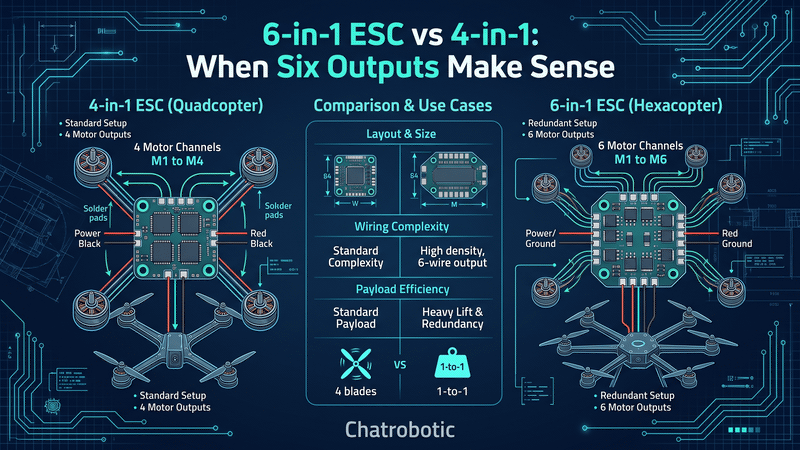
A 6-in-1 ESC is not a bigger 4-in-1. It is a different answer to the same question: where do you put six power stages when the airframe has six motors. On a hexacopter the choice is between one integrated board, six discrete ESCs, or a hybrid where four motors share a board and the outer pair run singles.
This guide covers what the six-output format actually solves, where it costs you, and how to decide with the numbers rather than by habit.
What "6-in-1" means in practice
Six independent motor outputs on one PCB, sharing an input, a capacitor bank and usually a single MCU family. The 150 A 6-in-1 board on this site carries a 120 A continuous rating per channel across all six outputs, with a 150 A ten-second peak, on 2-8S input, in an 85×52×15 mm package at 45 g.
That last number matters more than it looks. Six discrete single ESCs at roughly 11 g each — the weight of the 150 A single ESC — weigh about 66 g before you add six sets of wires, six mounting pads and the distribution harness. The integrated board lands at 45 g with shorter power paths.
The three numbers side by side
| 6-in-1 | 4-in-1 | Single ESC | |
| Outputs | 6 | 4 | 1 |
| Continuous per channel | 120 A | 85 A (on the 85 A 4-in-1) | 120 A |
| Burst | 150 A / 10 s | 100 A / 10 s | 150 A / 10 s |
| Input | 2-8S (12.6-33.6 V) | 2-8S (12.6-33 V) | 2-8S (8.4-33.6 V) |
| BEC | none on board | varies by board | 5 V @ 3 A + 12 V @ 3 A |
| Weight | 45 g | 16 g | 11 g each |
| Package | 85×52×15 mm | 54×45×8 mm | 50×28×6 mm |
Read the BEC row carefully: the 6-in-1 has no BEC at all. It expects the flight controller or a separate regulator to supply 5 V, which is normal at this current class but is a difference you have to plan for.
Where six outputs win
Genuine hexacopter layout. Six outputs on one PCB keeps the motor harness symmetric and short. With six singles you are routing six signal wires and six power pairs back to a distribution point, and every extra centimetre of power wire is inductance the FETs have to switch against.
Heavy propellers. The 6-in-1 firmware ships with an adaptive ramp-up for heavy props and stall protection, which is exactly the failure mode on a large-diameter, high-inertia propeller that starts against load.
Weight and volume budget. 45 g for six channels versus roughly 66 g plus harness for six singles, in a single flat package that mounts on the stack.
Telemetry uniformity. Two-way DShot across all six channels from one board means one firmware image and one set of settings, rather than six ESCs that can drift apart after a partial reflash.
Where it costs you
Single point of failure. One failed channel takes the airframe down. With six singles you replace one ESC; with a 6-in-1 you replace the board.
Thermal concentration. Six power stages on one PCB share one thermal mass and one airflow path. On a board this size, mounting orientation and clearance matter more than on a 4-in-1.
No BEC. You need a separate 5 V supply, and if that supply fails, the whole aircraft loses avionics regardless of how healthy the ESC is.
Repairability. A crashed arm can tear a pad off a 6-in-1 the same way it does on a 4-in-1, but the board you are replacing is larger and more expensive.
The hybrid option most builders overlook
You do not have to pick one architecture. A common compromise on heavy hexacopters is a 4-in-1 board driving the four inner motors and two single ESCs on the outer pair, which are the ones most exposed in a tip-over. You get the harness simplicity where it matters, and cheap, replaceable units on the arms that take the hits.
That layout costs you one more firmware target and two more sets of settings — which is the real price of the hybrid, not the weight.
Choosing between them
Count motors, then count crash exposure. If the outer motors are on long arms that routinely hit the ground, prefer replaceable singles or the hybrid.
Check the continuous rating against your measured draw, not against the burst figure. 120 A continuous per channel on 8S is a large amount of power; most 6-inch and 7-inch hexacopters will not approach it, which means the board is running comfortably derated.
Budget the 5 V rail separately. No onboard BEC means a flight controller BEC or a dedicated regulator, and that device needs its own current headroom for the receiver, VTX and camera.
Decide before you cut the frame. Mounting pattern and stack height drive which board fits. A 6-in-1 at 85×52 mm needs a frame with room for it, and a 30×30 stack will not accept it without an adapter plate.
Firmware and protocol notes
All the boards discussed here run 32-bit firmware with DShot support, and the 6-in-1 supports two-way DShot telemetry, which returns per-motor RPM and error rate to the flight controller without a separate telemetry wire. That is worth having on a hexacopter: RPM filtering depends on clean telemetry from every motor, and six channels reporting from one board keeps the timing consistent.
For builds where the propulsion controller is a separate high-current unit rather than an ESC, the same telemetry question applies over CAN — see our flight controller selection guide for how that bus is wired.
FAQ
Q: Can I use a 6-in-1 on a quadcopter?
A: You can, and two channels will sit idle. It is heavier and more expensive than a 4-in-1 for no benefit unless you plan to convert to a hexacopter later.
Q: Does a 6-in-1 need a bigger capacitor?
A: It needs a capacitor bank rated for the input voltage and the total ripple of six switching stages. Follow the board's own recommendation rather than reusing a 4-in-1 capacitor.
Q: Is the per-channel rating lower on a 6-in-1 because it shares one board?
A: Not necessarily — the rating reflects the FETs and thermal design, not the channel count. Compare continuous per-channel figures directly.
Q: Six singles or one 6-in-1 for a first hexacopter?
A: One 6-in-1, because the wiring is simpler and there is one firmware image to configure. Move to singles or the hybrid once crashes, not performance, become the limiting cost.


{{ commentCount }} Comments