
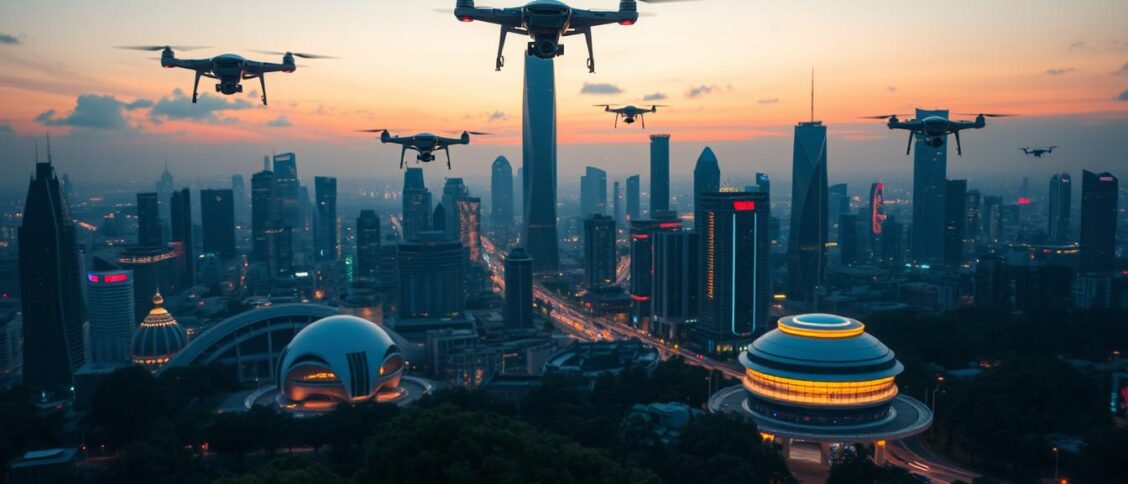
The Rise of AI in FPV: How Onboard Processing is Changing Autonomous Flight
The world of First Person View (FPV) drones is undergoing a revolutionary transformation, powered by the convergence of artificial intelligence and advanced onboard processing capabilities. What was once the exclusive domain of human pilots with lightning-fast reflexes is now becoming a sophisticated ecosystem of autonomous systems that can see, think, and react in real-time. This technological shift is not replacing human pilots but augmenting their capabilities and creating entirely new possibilities for drone applications. In this comprehensive exploration, we examine how onboard AI processing is fundamentally changing autonomous flight and what this means for the future of FPV technology.
From Human Reflex to Machine Intelligence: The Evolution of FPV
Traditional FPV flying has always been about the direct connection between pilot and machine. The thrill of flying at high speeds through complex environments relied entirely on human perception, decision-making, and muscle memory. Pilots developed an almost instinctual understanding of their drones, reading subtle visual cues from their video feeds to navigate challenging courses.
This human-centric approach, while incredibly impressive, had inherent limitations. Human reaction times, while remarkably fast, have physical limits. Fatigue, distraction, and sensory overload could lead to mistakes. Complex maneuvers required extensive training, and certain environments posed risks that even experienced pilots might hesitate to tackle.
The integration of AI and onboard processing represents a paradigm shift. Instead of relying solely on the pilot's brain, modern FPV systems now incorporate their own "brain" that can process visual information, make split-second decisions, and execute maneuvers with precision that surpasses human capabilities in specific contexts.
The Hardware Revolution: Onboard Processing Capabilities
The foundation of AI-powered FPV is the remarkable advancement in processing hardware that can now be carried onboard even small, agile drones. Specialized processors like the NVIDIA Jetson series, Qualcomm Snapdragon Flight platforms, and custom AI accelerators have become compact and energy-efficient enough to fit within FPV frames.
These processors differ fundamentally from traditional flight controllers. They're designed specifically for parallel processing of visual data, capable of running complex neural networks in real-time. With dedicated tensor cores and optimized architectures for machine learning tasks, they can process high-resolution video feeds at incredibly low latency while consuming minimal power.
The evolution has been dramatic. Early attempts at onboard processing used underpowered chips that could barely handle basic stabilization algorithms. Today's systems can run sophisticated computer vision models while simultaneously managing flight control, sensor fusion, and communication—all within the tight weight and power constraints of FPV platform
Key AI Capabilities Transforming FPV Flight
Real-Time Obstacle Detection and Avoidance
One of the most significant advancements enabled by onboard AI is real-time obstacle detection and avoidance. Traditional FPV drones relied entirely on pilot vision to avoid obstacles, making high-speed flight through complex environments extremely risky. AI systems can now analyze the video feed in real-time to identify potential obstacles and automatically adjust flight paths.
These systems use convolutional neural networks trained on millions of images to recognize various obstacle types—trees, buildings, wires, and other drones. More advanced systems employ semantic segmentation that doesn't just detect obstacles but understands what they are, enabling more intelligent avoidance strategies. A thin branch requires different handling than a solid wall, and AI systems can now make these distinctions in milliseconds.
Autonomous Navigation in Unknown Environments
Onboard AI enables FPV drones to navigate through completely unknown environments without pre-existing maps or GPS guidance. Using simultaneous localization and mapping (SLAM) algorithms enhanced with deep learning, drones can build real-time 3D maps of their surroundings while maintaining precise positional awareness.
This capability is particularly valuable for search and rescue operations, inspection missions, and exploration in GPS-denied environments. The drone can autonomously explore a collapsed building, underground facility, or dense forest while creating a detailed map and identifying points of interest—all without human guidance beyond the initial mission parameters.
Intelligent Flight Path Optimization
AI-powered FPV systems don't just avoid obstacles; they optimize entire flight paths for efficiency, speed, and safety. Using reinforcement learning algorithms, drones can learn to fly complex courses more efficiently than human pilots in certain scenarios.
These systems analyze multiple potential flight paths in real-time, considering factors like wind conditions, battery life, mission objectives, and obstacle positions. They can execute complex racing lines with millimeter precision or find the most efficient inspection route through industrial equipment—adapting in real-time to changing conditions.
Gesture and Intent Recognition
Advanced AI systems are beginning to incorporate human gesture recognition and intent prediction, creating more intuitive human-drone interfaces. Instead of relying solely on traditional controller inputs, pilots can use gestures to command their drones or the system can anticipate pilot intentions based on flight patterns.
This creates a synergistic relationship where the AI handles low-level stabilization and obstacle avoidance while responding to high-level human commands, essentially serving as an intelligent copilot that understands not just what the pilot is doing but what they're trying to achieve.
The Software Stack: Neural Networks and Algorithms
The hardware revolution is enabled by equally impressive advances in software. Modern AI FPV systems run sophisticated stacks of algorithms that work in concert to enable autonomous capabilities.
At the foundation are computer vision models that process the video feed. These have evolved from simple edge detection to complex architectures like YOLO (You Only Look Once) for object detection and DeepLab for semantic segmentation. These models are optimized for the specific challenges of FPV—high speeds, motion blur, and rapidly changing perspectives.
Sensor fusion algorithms combine data from multiple sources—cameras, inertial measurement units (IMUs), distance sensors, and sometimes LiDAR—to create a comprehensive understanding of the drone's environment and state. AI enhances this fusion, learning to weigh different sensor inputs based on reliability in various conditions.
Control algorithms have also evolved. Traditional PID controllers are being supplemented or replaced by neural network controllers that can learn optimal control strategies through simulation and real-world experience. These adaptive controllers can compensate for damage, changing aerodynamics, or unusual flight conditions that would confuse traditional systems.
Training the AI: Simulation to Reality
One of the key challenges in developing AI for FPV is training the neural networks. Real-world crashes during training would be impractical and expensive. The solution has been the development of highly realistic simulation environments where AI systems can learn without risk.
Platforms like Microsoft AirSim, FlightGoggles, and custom simulation environments create photorealistic virtual worlds with accurate physics modeling. AI systems can practice millions of flights in these simulators, encountering every possible scenario from simple obstacle courses to complex urban environments with dynamic elements.
The training process typically involves reinforcement learning, where the AI learns through trial and error, receiving rewards for successful navigation and penalties for crashes. More advanced approaches use imitation learning, where the AI learns by watching expert human pilots, or curriculum learning, where the difficulty increases gradually as the AI masters simpler tasks.
The transition from simulation to reality—known as the sim-to-real gap—remains challenging but is being addressed through techniques like domain randomization (varying simulation parameters so the AI learns robust strategies) and real-world fine-tuning (limited real-world training to adapt simulation-learned policies).
Applications and Use Cases
Racing and Acrobatics
In FPV racing, AI is transforming both competition and training. Autonomous racing drones can now complete complex courses with superhuman precision, setting benchmarks for human pilots. More practically, AI systems can serve as training partners that analyze a pilot's performance and suggest improvements or recreate competitor lines for practice.
Cinematography and Film Production
For filmmakers, AI-powered FPV systems enable shots that were previously impossible or required multiple takes. Intelligent camera tracking can maintain perfect framing of fast-moving subjects while avoiding obstacles. Pre-programmed cinematic maneuvers can be executed with perfect repeatability, while AI-enhanced stabilization produces buttery-smooth footage even in challenging conditions.
Industrial Inspection and Maintenance
In industrial settings, AI FPV drones can autonomously navigate complex machinery, infrastructure, or facilities to perform visual inspections. They can identify anomalies like cracks, corrosion, or heat signatures, documenting their findings systematically. This significantly reduces inspection time and improves safety by keeping human inspectors away from hazardous environments.


{{ commentCount }} Comments