
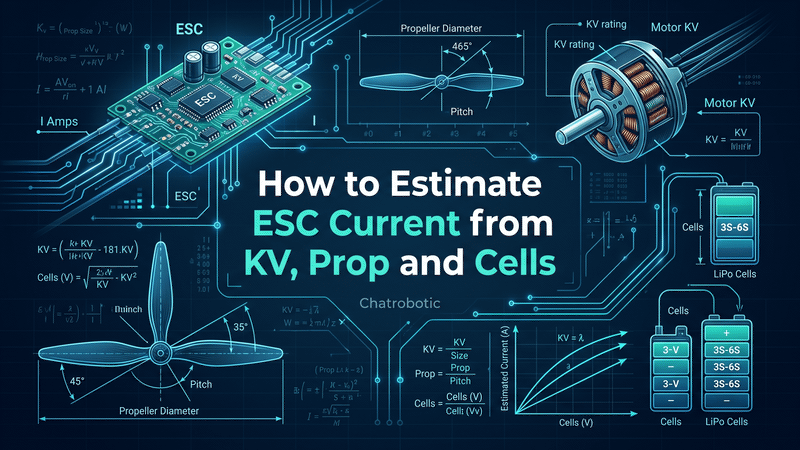
Motor KV, propeller size and cell count are not independent choices. Change one and the current draw moves in a direction you can predict, which is why an ESC can be correctly rated on paper and still burn on the first punch-out. This guide gives the scaling relationships, one worked estimate, and the places where the arithmetic stops matching reality.
The three variables and what they control
KV is RPM per volt with no load. It sets how fast the motor wants to spin for a given pack, and therefore how much power the propeller absorbs.
Propeller diameter and pitch set how much power is required to spin at that RPM. Diameter dominates; pitch is secondary.
Cell count sets the voltage that drives RPM. It is the variable people change most casually and the one that moves current the most.
The scaling relationships
These are approximations from momentum and blade-element theory. They are accurate enough to rank designs, not accurate enough to replace a bench test.
| If you change… | Thrust scales as | Power scales as | Current scales as |
| Diameter, at fixed RPM | D⁴ | D⁵ | D⁵ |
| RPM, at fixed propeller | RPM² | RPM³ | RPM³ |
| Voltage, at fixed KV and propeller | V⁴ | V³ | V² |
| Voltage, at fixed RPM (KV scaled inversely) | — | — | 1/V |
Read the first row and then think twice before moving from a 5-inch to a 7-inch propeller on the same motors. At the same RPM, power rises with the fifth power of diameter. A 40 % increase in diameter multiplies power by roughly 5.4×, not 1.4×.
The trap: 12S does not halve your current by itself
"Higher voltage means lower current" is only true if you keep the RPM the same. Two different things can happen when you move from 6S to 12S:
You halve the KV to hold RPM. Same propeller speed, same mechanical power, current halves. This is the case people mean, and the reason a 12S airframe can use thinner conductors and a smaller ESC for the same thrust.
You keep the KV. RPM rises by 33 %, power rises by about 2.4×, and because current equals power divided by voltage, current rises by roughly 78 %. The ESC you thought you were de-rating is now working harder.
That second case is the single most common cause of a 12S build destroying an ESC that was "oversized" on paper. The current only falls if the propeller speed stays put.
A worked estimate
Take a 5-inch freestyle quad: 6S pack, 2207-class motors around 1800 KV, 5.1×4.6 three-blade propeller. A typical full-throttle bench figure for that combination is in the 30-40 A per motor range, and hover sits far below it, usually under a third of that.
Now apply the voltage row. If you keep the same motors and prop and move to 8S, current scales roughly as V², so a 40 A peak becomes about 70 A. That is the difference between a comfortable 85 A board and one running at its limit:
| Pack | Relative current (fixed KV) | Peak per motor, from a 40 A / 6S baseline |
| 4S | 0.44× | ≈ 18 A |
| 6S | 1.00× | 40 A |
| 8S | 1.78× | ≈ 71 A |
| 12S | 4.00× | ≈ 160 A |
The last row is why nobody runs 1800 KV motors on 12S. The build would need either a much smaller propeller or a KV roughly a quarter as high — and at that point the current falls back to about the 6S figure.
Where the estimate breaks down
Static versus flying load. A bench test with the quad clamped down holds the propeller at its highest-load condition. In forward flight the propeller unloads, so in-flight current is usually below the static peak — but the peak still happens on every punch-out, which is what the ESC has to survive.
Voltage sag. A pack under load drops below nominal, so RPM and power fall with it. Two batteries of the same cell count but different internal resistance will not produce the same current.
Motor efficiency. The scaling laws describe input power to the propeller, not losses in the motor. A hot motor converts some of that power into heat, which shows up as current that does not produce thrust.
Timing and PWM. A poorly matched timing setting can add several percent to current draw for no gain in thrust. It is the cheapest thing to check before blaming the propeller.
Turning the estimate into an ESC rating
Take the worst-case prop you intend to fly, not the one you flew yesterday.
Use the vendor's max current for that prop and cell count as the starting number. If there is no published figure, estimate from the scaling table and treat it as a lower bound.
Add headroom for heat. Size 20-30 % above the estimated peak, more if the board is enclosed or the frame is ducted.
Check the total, not just the channel. Four channels at 85 A is 340 A on the input side. Confirm the connector, the pad and the capacitor bank can take it.
Confirm with a short flight log. Hover and one punch-out will tell you more than any table.
Which board that points to
| Build | Typical peak per motor | Board |
| Sub-250 g, 3-inch, 4S | under 30 A | 30 A mini 4-in-1, 20×20 |
| 5-inch freestyle, 6S | 30-45 A | 75 A or 85 A 4-in-1 |
| 7-inch long range, 6S-8S | 45-70 A | 85 A 4-in-1, verify airflow |
| High cell count, current kept low by design | 60-100 A | 12S 120 A 4-in-1 |
| Above 100 A per motor | 100 A + | 150 A single ESC per motor |
FAQ
Q: Does a higher KV always mean more current?
A: At the same propeller and voltage, yes — power rises with the cube of KV. Pair a high-KV motor with a smaller propeller and the balance can be restored.
Q: Why does my current drop when I go to a smaller propeller?
A: Because power scales with roughly the fifth power of diameter at fixed RPM. Small diameter changes produce large current changes.
Q: Can I estimate current from thrust?
A: Roughly, via propulsive efficiency, but the error is large enough that it is not worth the effort for ESC sizing. Measure or use the motor vendor's published figures.
Q: Is burst current the number I should size for?
A: Size for continuous, then confirm the burst rating covers your worst-case punch-out. A board that only meets your peak in burst mode will run hot for the whole flight.




{{ commentCount }} Comments