
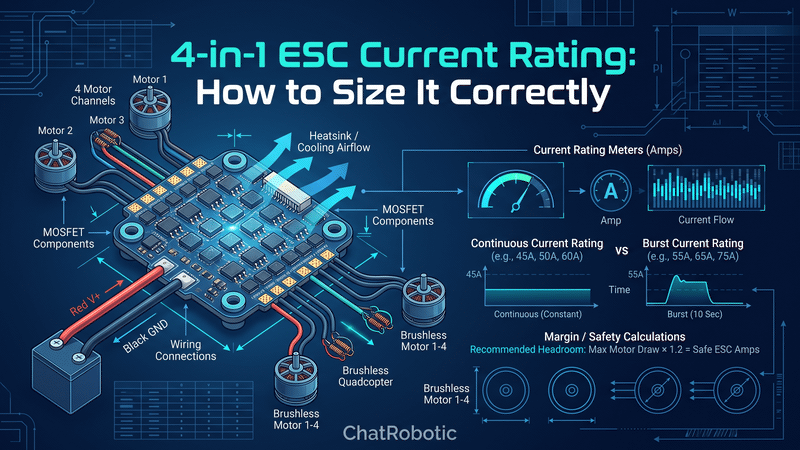
The current number printed on a 4-in-1 ESC is the least reliable figure in an FPV build. It is a per-channel figure measured on a bench, at a specific airflow, with a specific propeller, and it is often quoted alongside a "total board current" that no quad ever draws evenly across four channels.
This guide explains what the three current numbers on a 4-in-1 datasheet actually mean, how to estimate your own per-motor draw, and how to choose between the ratings on this site — from a 30 A 20×20 mini board up to a 12S 120 A unit.
Three current numbers, three different meanings
Every 4-in-1 datasheet you will read uses the same three figures, and buyers routinely conflate them:
Continuous current per channel. What one motor phase output can sustain indefinitely, given airflow. This is the number that should drive your choice.
Burst current per channel. A short-duration ceiling, usually stated with a time limit. On the boards below it is a 10-second figure — long enough for a punch-out, far too short to average over a flight.
Total board current. The sum the PCB and input connector can survive, which is not four times the per-channel figure in practice. Current is never shared evenly: in a hard yaw or a prop-strike recovery, one channel can pull well above its share.
So "85 A" on a box does not mean your quad can run 340 A continuously. It means one channel, with air moving over the FETs, can hold 85 A.
Where the airflow assumption comes from
Continuous ratings are bench figures with the board exposed. In a real airframe the ESC sits under a stack, behind a battery strap, or inside a ducted frame with limited exchange. Two consequences follow:
If your build buries the board, treat the continuous rating as an upper bound rather than a target.
Thermal shutdown is not a failure mode you will notice on the bench. It appears as a brief motor desync or a throttle cut mid-flight, which pilots usually misdiagnose as a tune problem.
A common rule of thumb in FPV builds is to size the ESC 20–30 % above your measured peak per-motor current, then confirm with a short hover log that the board is not saturating.
Voltage changes the current, not the power
For a given propeller and motor, mechanical power is roughly fixed by the RPM you are asking for. Since current equals power divided by voltage, moving from 4S to 6S at the same power reduces the current by a third — and from 6S to 12S, by half again.
That is the entire reason 12S boards exist, and it is the most useful lever for a heavy build:
| Pack | Nominal | Relative current for the same power |
| 4S | 14.8 V | 1.50× |
| 6S | 22.2 V | 1.00× |
| 8S | 29.6 V | 0.75× |
| 12S | 44.4 V | 0.50× |
The move to 12S is what makes a 12S 120 A 4-in-1 board interesting: it delivers the current headroom of a much larger 6S board at half the conductor loss, because it is running 4S–12S input with a 100 A continuous and 120 A ten-second rating per channel.
The catch is that 12S demands more from everything around the ESC — capacitor voltage rating, BEC input range, and motor insulation. Do not treat a 12S board as a drop-in for an 8S build without checking the whole chain.
The current board lineup, by real numbers
These are the published per-channel figures for the 4-in-1 boards on this site, all built on 32-bit MCUs with DShot support:
| Board | Continuous | Burst | Input | PWM | Mount / size |
| 30 A Mini 4-in-1 | 30 A | 80 A / 10 s | 2–8S (7.4–25.2 V) | 8–32 kHz | 20×20, 30×20 mm, 6.5 g |
| 50 A Mini 4-in-1 | 45 A | 80 A / 10 s | see product page | 8–32 kHz | 20×20, 6.5 g |
| 75 A 4-in-1 | 75 A | 90 A / 10 s | 2–8S (12.6–33.2 V) | 8–48 kHz | 54×45×8 mm, 16 g |
| 85 A 4-in-1 | 85 A | 100 A / 10 s | 2–8S (12.6–33 V) | 8–48 kHz | 54×45×8 mm, 16 g |
| 12S 65 A 4-in-1 | 65 A class | — | up to 12S, NDAA | DShot | 30×30 |
| 12S 120 A 4-in-1 | 100 A | 120 A / 10 s | 4S–12S, NDAA | AM32 | 30×30 |
Two notes on reading that table. The 30 A mini and the 75/85 A boards share the same AT32F421K8U7 processor, so the difference between them is the power stage and the thermal path, not the firmware capability. And the 12S boards use an STM32G071 with AM32 firmware, which is a different toolchain from the F421 boards.
Working out what you actually need
You do not need a thrust stand to get a defensible number. Three steps get you close:
Estimate peak per-motor current from your build sheet. Most motor vendors publish a max current for a stated prop and cell count. Take the highest prop you intend to run, not the one you flew last week.
Add the derating for your airframe. Ducted frames and tightly packed stacks run hotter than an open 5-inch. If the board is enclosed, do not plan to sit at the continuous rating.
Verify with a hover log. A 30-second hover tells you the real continuous draw far better than the spec sheet. If hover sits at 40 % of the rating, you have margin; if it sits at 80 %, a punch-out will spend the rest of it.
For a typical 5-inch freestyle quad on 6S, the 75 A and 85 A boards cover most builds; the 30 A mini belongs on a lightweight 3-inch or a sub-250 g build where the whole quad weighs less than a battery. The 12S boards are for high-cell-count airframes where the point is to keep current low.
Sizing mistakes that show up as crashes
Sizing to the burst number. A board rated 100 A for 10 seconds will survive a punch-out; it will not survive a 4-minute flight at 90 A.
Ignoring the input connector. The XT60 or pad is part of the current path. A 4-in-1 rated 340 A total is meaningless if the input is a single small pad with a cold joint.
Forgetting the BEC budget. A 5 V 3 A switch-mode BEC has to run the receiver, the VTX, the camera and the flight controller. A high-power VTX alone can take a large share of that.
Mixing cell counts across the build. An 8S-rated board on a 12S pack is not a derating question, it is a failure waiting for the first throttle input.
When a 4-in-1 is the wrong answer
Above roughly 85 A per channel, a 4-in-1 stops being the practical choice: the PCB becomes a heatsink problem, and a single failed channel costs you the whole board. At that point a single ESC per motor, or a high-current controller such as the VESC controller range for larger airframes, is the better architecture.
If your build has six motors rather than four, see our comparison of 6-in-1 and 4-in-1 boards.
FAQ
Q: Can I run a 4-in-1 at its continuous rating all flight?
A: Only with airflow over the board and a per-motor draw that never exceeds it. Most builds should treat the continuous number as a ceiling, not a target.
Q: Does a higher PWM frequency give more current capability?
A: No. Higher PWM reduces torque ripple and can improve smoothness, at the cost of more switching loss and heat. It does not raise the current rating.
Q: Is a 12S board always better?
A: Only if the rest of the build is 12S-rated. For the same power, 12S halves the current, but it also raises the voltage stress on capacitors, BECs and motor insulation.
Q: Why does my 85 A board run hotter than my 75 A board at the same throttle?
A: Same package, same processor, different FETs and a different current ceiling. If both are running near their limit, the higher-rated board is closer to saturation and will run hotter, not cooler.


{{ commentCount }} Comments