Quick Takeaway (TL;DR): Dual-motor VESC powertrain architectures divide into two distinct engineering tiers: 57V integrated single-PCB controllers (such as the VESC-LS V5 benchmark, delivering ~11 kW combined for lightweight, space-constrained commuter builds) and 26S–32S (109.2V–134.4V) CAN-distributed dual platforms (utilizing dual ChatRobotic TRONIC X12 PRO or SEVEN 18 units, delivering 28 kW to 100 kW+ combined output). Sizing comes down to required mechanical torque, continuous thermal dissipation limits, and vehicle-level electrical headroom.
1. Electromechanical Topology: Single-PCB Dual vs. CAN-Distributed Multi-Node
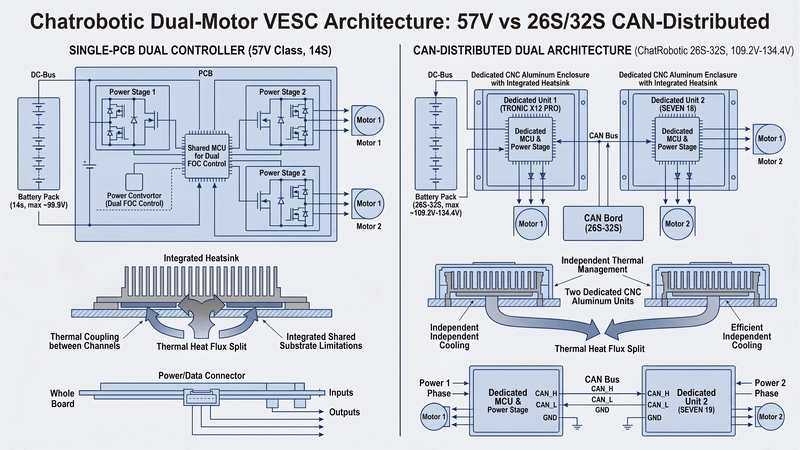
When designing a dual-motor electric vehicle, mobile robot, or all-wheel-drive powertrain, selecting between a single integrated dual-channel inverter board and two independent CAN-synchronized controllers involves major thermal and layout tradeoffs.
Architectural Comparison:
•Integrated Single-PCB Dual Controller (57V Class / Reference: VESC-LS V5)
•Packaging: 12 MOSFETs sharing one compact substrate
•Inverter Topology: Dual 3-Phase Bridges on Shared DC Bus
•Thermal Bottleneck: Concentrated Heat Flux in Enclosed Decks
•Primary Limit: Fixed Maximum Voltage Ceiling (~57V Max Input)
•CAN-Distributed Dual Architecture (ChatRobotic 26S–32S Class)
•Packaging: Two Dedicated Monolithic CNC Aluminum Enclosures
•Inverter Topology: Independent 3-Phase Stages Linked Over CAN Bus
•Thermal Dissipation: Split-Zone Direct Chassis Heat Sinking
•Scalability: Up to 134.4V Bus Voltage & 993A Phase Current per Channel
Thermal Dissipation and Shared Substrate Limits
In a single-PCB dual controller, 12 or more MOSFETs discharge switching and conduction heat onto a shared ground plane. The total inverter conduction loss across both motor channels is modeled as:
Total Conduction Loss (W) = 2 × [3 × (I_rms)^2 × R_ds(on)]
Where:
•I_rms is the continuous root-mean-square phase current per motor channel.
•R_ds(on) is the static channel resistance at elevated junction temperatures (T_j ≈ 100°C to 125°C).
When two motor channels operate simultaneously at 210A continuous current within a single compact PCB enclosure, localized thermal saturation occurs rapidly, forcing early thermal rollback. In contrast, the CAN-distributed architecture physically separates the two inverter power stages into dedicated CNC billet aluminum enclosures, cutting heat flux per unit area in half and allowing individual direct coupling to the vehicle's structural frame.
To evaluate basic electrical sizing, phase current vs. battery current conversion, and foundational math across the entire hardware range, refer to the complete 2026 VESC buyer's guide.
2. Voltage Scaling & Power Output Dynamics (57V vs. 26S/32S)
Electrical power is the product of bus voltage and current:
Total Output Power (W) = V_bus × I_bus
To achieve 15 kW of electrical power:
•A 57V (14S) Platform must draw approximately 263A from the battery pack.
•A 109.2V (26S) Platform requires only 148A of bus current for identical kilowatt output.
High-Voltage Engineering Advantages:
•Cabling Resistive Loss Reduction:
•Formula: Harness Loss (W) = (I_bus)^2 × R_harness
•Impact: Cutting bus current by ~45% reduces copper harness heating by >65%.
•Transient Voltage Headroom:
•57V Class: Uses 100V-rated MOSFETs with limited margin above high-speed regen spikes.
•26S/32S Class: ChatRobotic hardware utilizes 120V–150V automotive TOLT MOSFETs backed by 160V DC-DC supplies, absorbing massive regenerative surges without punch-through.
The 57V Low-Voltage Benchmark (VESC-LS V5)
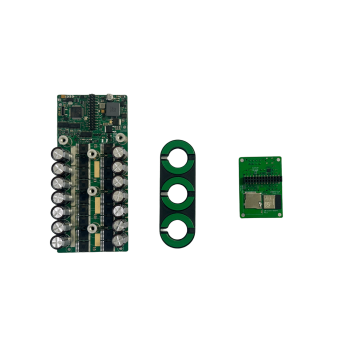
The VESC-LS V5 is an established third-party 57V dual-motor controller used here solely as an engineering reference point for the 57V low-voltage class, not as a ChatRobotic product.
•Reported Reference Specifications: Up to 57V (14S Li-ion), ~210A continuous per channel, ~240A burst (10 s), 12× Infineon IPT015N10N5 TOLT MOSFETs, integrated dual power stage.
•Application Fit: Excellent for compact, lightweight builds where deck space and pack weight strictly limit the battery to 14S and continuous mechanical power remains under ~11 kW.
•Hardware Policy: ChatRobotic does not manufacture sub-100V integrated dual controllers. All ChatRobotic systems begin at 26S (109.2V) and scale to 32S+ (134.4V–140V) to serve high-power commercial robotics, performance electric mobility, and industrial drivetrains.
3. Comprehensive Technical Specification Benchmark
| Technical Parameter | 57V Low-Voltage Reference (VESC-LS V5) | Dual TRONIC X12 PRO 26S Pair | Dual SEVEN 18 26S Pair | Dual SEVEN 18 32S Pair |
| Max Battery Voltage | 57.0V DC (~14S Li-ion) | 109.2V DC (26S Li-ion) | 109.2V DC (26S Li-ion) | 134.4V DC (32S Li-ion) |
| Silicon Breakdown (V_ds) | 100V MOSFETs | 120V MOS / 160V DC-DC | 150V MOS / 160V DC-DC | 150V MOS / 160V DC-DC |
| Continuous Current / Ch. | ~200A (Integrated) | 463A (Liquid Cooled) | ~695A (Active Cooling) | ~554A (Active Cooling) |
| Peak Current (10 s) / Ch. | ~240A Burst | 662A Phase Current | 993A Phase Current | 792A Phase Current |
| Combined Rated Power | ~11 kW Peak | ~46 kW Continuous Rated | ~100 kW+ Peak Output | ~100 kW+ Peak Output |
| Power Stage Topology | 12× Single-Board Dual | 2× (12× Infineon TOLT) | 2× (18× Infineon TOLT) | 2× (18× Infineon TOLT) |
| Inter-Controller Link | Internal PCB Traces | Isolated CAN Bus (Microsecond Sync) | Isolated CAN Bus (Microsecond Sync) | Isolated CAN Bus (Microsecond Sync) |
| Integrated Sensors | Analog ADC / Remote | Dual 6-Axis IMUs (BMI/ICM) | Dual 6-Axis IMUs (BMI/ICM) | Dual 6-Axis IMUs (BMI/ICM) |
| Wireless Telemetry | Vendor Dependent | ESP32-C3 BLE (VESC Express) | ESP32-C3 BLE (VESC Express) | ESP32-C3 BLE (VESC Express) |
| Direct Hardware Links | Market Reference Only | X12 PRO 26S Details | SEVEN 18 26S Details | SEVEN 18 32S Details |
For higher voltage or extreme continuous current options, browse the complete ChatRobotic VESC Motor Controllers Catalog.
4. Field Commissioning & Multi-Node CAN Synchronization
Running two independent ChatRobotic VESC controllers as a synchronized dual-motor drive eliminates single-point electrical failures while enabling electronic differential torque vectoring.
Dual-Drive Commissioning Sequence:
•Step 1: Pre-charge & Wiring Inspection
•Power both units from a common battery bus through anti-spark connectors.
•Connect CAN_H, CAN_L, and Signal Ground between controllers (Twisted Pair).
•Step 2: Independent FOC Motor Detection
•Connect to Master Unit via USB-C -> Run FOC Wizard (R, L, Lambda, Hall/Encoder).
•Connect to Slave Unit via USB-C -> Run FOC Wizard on secondary motor.
•Step 3: CAN Bus Node Configuration in VESC Tool
•Master Controller: Set App to ADC/PPM (Remote), CAN ID = 0, Send CAN Status = ON.
•Slave Controller: Set App to None, CAN ID = 1, Send CAN Status = ON.
•Enable 'Traction Control' or 'Torque Vectoring' in VESC Tool Master App Settings.
•Step 4: Thermal Cutoff Calibration (75°C Start / 95°C Hard Rollback)
Practical Build Applications
•Dual-Motor Racing E-Skateboards: Twin TRONIC X12 PRO 26S units provide 1324A combined peak phase current, eliminating thermal saturation on steep hill climbs. Follow our VESC Electric Skateboard DIY Build Guide.
•High-Torque Dual-Actuator Robotics / AGVs: Twin SEVEN 18 26S or TRONIC 250R 125V (27S) units communicate with ROS/ROS2 compute modules over isolated CAN, providing millisecond differential wheel velocity control.
•Self-Balancing Platforms & Single-Wheel Upgrades: If your project transitions to self-balancing single-drive mechanics, review our VESC Onewheel Upgrade and Customization Guide.
5. High-Voltage System Integration & ChatRobotic Turnkey OEM Solutions
Transitioning dual-motor drive designs from prototype to commercial volume production requires enterprise-grade hardware reliability, thermal validation, and supply chain security. ChatRobotic delivers end-to-end engineering manufacturing services:
•Matched High-Torque Motors: Native electrical and mechanical compatibility with ChatRobotic LandDrive (traction/direct-drive), AirDrive (aerial propulsion), and SeaDrive (marine propulsion) high-power motors.
•NDAA-Compliant Electronic Manufacturing: Certified supply chains free of restricted telecommunications and semiconductor components, suitable for aerospace, defense, and commercial robotics contracts.
•Custom Firmware & Communication Stacks: Tailored VESC firmware forks featuring proprietary CAN message sets, custom dual-drive differential algorithms, and hardware safety interlocks.
•Turnkey PCBA & CNC Thermal Machining: ISO9001/14001 certified rapid surface-mount assembly, high-durability CNC aluminum enclosures, and IP67 waterproof potting options.
Frequently Asked Questions (FAQs)
Q1: Does ChatRobotic offer a 57V single-board dual-motor controller like the VESC-LS V5?
A: No. ChatRobotic specializes exclusively in high-voltage, high-reliability powertrain electronics starting at 26S (109.2V) and scaling past 32S (134.4V–140V). For projects locked into a 57V battery pack and requiring a single integrated dual board, third-party 57V units represent the market option. For applications requiring more power, headroom, and thermal isolation, we recommend dual 26S ChatRobotic controllers linked over CAN bus.
Q2: Why is running two separate VESC controllers over CAN bus superior to a single integrated dual board?
A: A CAN-distributed dual setup physically separates the two inverter stages, preventing localized thermal saturation on a single PCB substrate. It also eliminates single-point failures (if one channel is damaged, the other remains functional), allows flexible chassis placement, and enables true independent phase current delivery up to 993A per channel.
Q3: How do two ChatRobotic VESC controllers maintain synchronized traction?
A: When linked over CAN bus, the Master controller processes input from the throttle or RC receiver, calculates the required torque vector, and broadcasts synchronized current setpoints to the Slave controller over CAN with sub-millisecond latency. VESC firmware includes built-in electronic traction control to limit wheel spin if one side loses surface grip.
Q4: Can I run a 26S ChatRobotic controller on a 12S or 14S (50V) battery pack?
A: Yes. The TRONIC 250R supports input voltages down to 8S (24V), while the TRONIC X12 PRO operates down to 8S/10S. Running 26S-rated hardware on a lower voltage pack provides massive electrical and thermal safety margins against voltage spikes and overcurrent.
Q5: When is migrating from a 26S dual setup to a 32S dual setup necessary?
A: Migrating to 32S (134.4V nominal) is required when you need higher motor mechanical RPM without rewinding stator coils, or when scaling continuous powertrain output beyond 20 kW while reducing current-induced heat across main wiring harnesses and battery interconnects.
Need Custom High-Power Powertrain Engineering?
Explore the complete ChatRobotic VESC Motor Controllers Catalog or get in touch with our engineering team for custom dual-drive CAD/STEP models, specialized 26S–32S+ power stages, and volume OEM/ODM manufacturing: Contact ChatRobotic Engineering


{{ commentCount }} Comments