
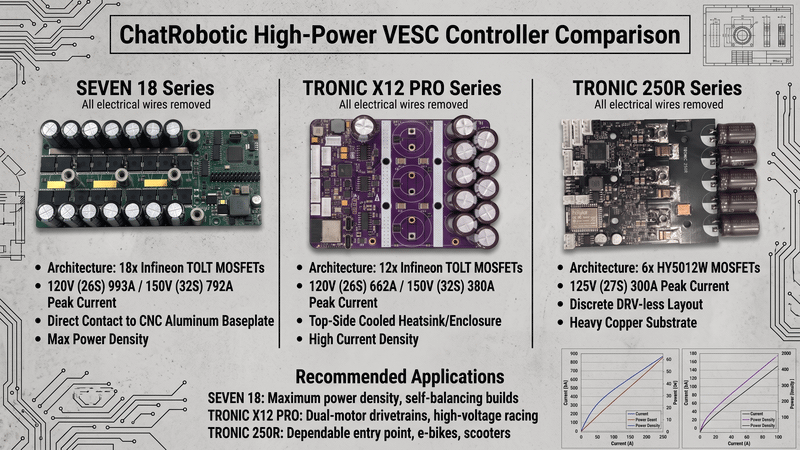
Quick Takeaway (TL;DR): Choosing among ChatRobotic's high-power VESC motor controllers depends on phase current demand, voltage class (26S vs. 32S), and chassis space constraints. Select the SEVEN 18 (120V (26S) 993A / 150V (32S) 792A, from $450) for maximum power density and demanding self-balancing builds; choose the TRONIC X12 PRO (120V (26S) 662A / 150V (32S) 380A, from $299) for dual-motor drivetrains and high-voltage racing; select the TRONIC 250R (125V (27S) 300A, from $150) as a dependable, DRV-less entry point for e-bikes, scooters, and light robotics.
1. Architectural Comparison & Power Density Matrix
All three controllers run open-source VESC Field-Oriented Control (FOC) firmware and feature onboard 6-axis IMUs, integrated Bluetooth, and CAN-bus synchronization. However, their internal power stages, MOSFET counts, and thermal dynamics reflect distinct engineering targets.
Power Stage Topology Comparison:
•SEVEN 18 Series
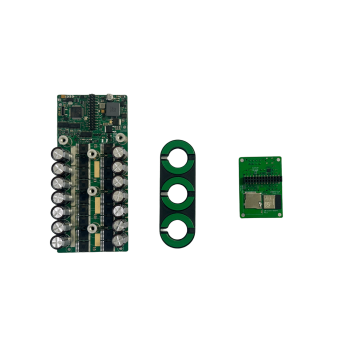
•Architecture: 18× Infineon TOLT Automotive MOSFETs — IPTC017N12NM6ATMA1 (26S) / IPTG025N15NM6ATMA1 (32S), 3 parallel switches per position
•Thermal Dissipation: Top-Side Cooled Direct Contact to CNC Aluminum Baseplate
•Power Density: ~3.5 A/cm³ (26S peak) — highest absolute peak current in the compact class
•TRONIC X12 PRO Series
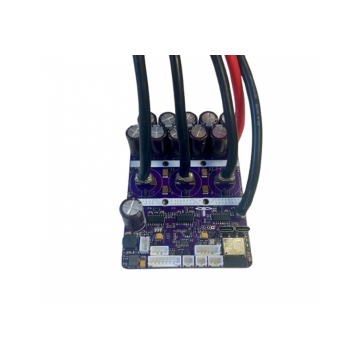
•Architecture: 12× Infineon TOLT Automotive MOSFETs — IPTC017N12NM6ATMA1 (26S) / IPT039N15N5ATMA1 (32S), 2 parallel switches per position
•Thermal Dissipation: Top-Side Cooled Aluminum Heatsink / Optional Enclosure
•Power Density: ~4.3 A/cm³ (26S peak) — highest current per cubic centimetre in the lineup
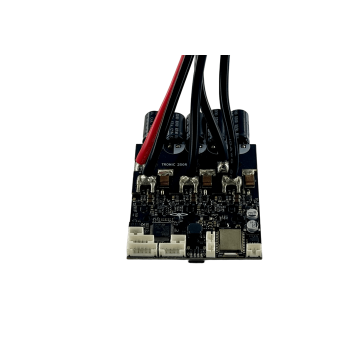
•TRONIC 250R Series
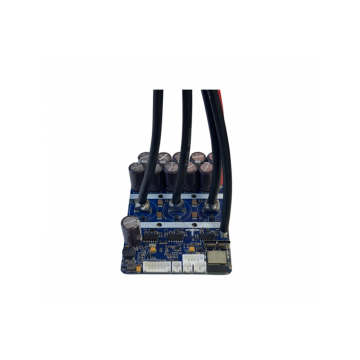
•Architecture: 6× HY5012W MOSFETs — 1 switch per position, discrete DRV-less layout
•Thermal Dissipation: Heavy Copper Substrate (4× DC-Link Copper Weight)
•Power Density: ~1.8 A/cm³ — value-optimised workhorse
Power Stage Conduction Loss Formulation
The efficiency and continuous thermal limit of each inverter are determined by total switch resistance and conduction loss:
•Effective Switch Resistance: R_switch_eff = R_ds(on) ÷ N_parallel
•Three-Phase Inverter Conduction Loss: Conduction Loss (W) = 3 × (I_rms)^2 × R_switch_eff
By paralleling 3 low-R_ds(on) Infineon TOLT MOSFETs per switch position, the SEVEN 18 achieves sub-milliohm channel resistance, allowing 993A peak burst currents without excessive junction heating. The TRONIC X12 PRO parallels 2 switches per position for 662A peak delivery, while the TRONIC 250R utilizes a single discrete HY5012W switch per position to optimize manufacturing cost while delivering 300A peak capacity.
To master the foundational physics of phase current sizing, voltage margins, and ERPM limits across the full ecosystem, review the complete 2026 VESC buyer's guide.
2. Comprehensive Technical Specification Benchmark
The table below outlines verified factory specifications across the three core product lines:
| Specification / Metric | SEVEN 18 | TRONIC X12 PRO | TRONIC 250R |
| Max Input Voltage | 120V (26S) / 150V (32S) | 120V (26S) / 150V (32S) | 125V (27S) |
| Max Pack Voltage | 109.2V (26S) / 134.4V (32S) | 109.2V (26S) / 134.4V (32S) | 113.4V (27S) |
| Recommended Battery | 10S–26S / 10S–32S | 10S–26S / 10S–32S | 10S–27S |
| Min Operating Voltage | 40V (10S) | 40V (10S) | 40V (10S) |
| Silicon Breakdown Rating | 120V MOS (26S) / 150V MOS (32S) | 120V MOS (26S) / 150V MOS (32S) | 125V MOS |
| MOSFET Array | 18× IPTC017N12NM6ATMA1 (26S) / 18× IPTG025N15NM6ATMA1 (32S) | 12× IPTC017N12NM6ATMA1 (26S) / 12× IPT039N15N5ATMA1 (32S) | 6× HY5012W |
| Peak Phase Current (10 s) | 993A (26S) / 792A (32S) | 662A (26S) / 380A (32S) | 300A |
| Continuous Current (Active) | 695A (26S) / 554A (32S) | 463A (26S) / 266A (32S) | 210A |
| Gate Driver Architecture | DRV-less (EV-derived discrete) | DRV-less (EV-derived discrete) | DRV-less (EV-derived discrete) |
| Board Construction | 2 boards, ×3 copper (4× DC-link copper weight) | 2 boards, ×3 copper (4× DC-link copper weight) | 2 boards, ×3 copper (4× DC-link copper weight) |
| Integrated Sensors | Built-in 6-axis IMU + thermal sensor extension | Built-in 6-axis IMU + thermal sensor extension | Built-in 6-axis IMU + thermal sensor extension |
| Wireless Connectivity | Integrated Bluetooth transceiver | Integrated Bluetooth transceiver | Integrated Bluetooth transceiver |
| Wired Interfaces | CAN bus, USB-C, Molex 43045 serial header | CAN bus, USB-C, JST PH2.0 serial header | CAN bus, USB-C, PH2.0 serial header |
| Input & Phase Connector | 5× screw terminals | 4× 8AWG (280 mm) + 1× 8AWG (250 mm) | 1× QS8-S 180 mm + 3× 4.0 mm bullets |
| Thermal Protection | Soft & hard thermal limiting | Soft & hard thermal limiting | Soft & hard thermal limiting |
| Dimensions (Bare Board) | 145 × 65 × 30 mm | 95 × 73 × 22 mm | 84 × 72 × 28 mm |
| Weight | 0.40 kg bare / 0.70 kg with case | 0.40 kg | 0.40 kg |
| Starting List Price | from $450 (Bare) / $550 (Case) | from $299 (regularly $450) | from $150 (regularly $299) |
| Direct Purchase Links | SEVEN 18 26S (with case) · SEVEN 18 32S | X12 PRO 26S · X12 PRO 32S | TRONIC 250R |
Prices and stock statuses verified via ChatRobotic factory listings. Verify at purchase.
3. Hardware Selection Matrix by Engineering Criteria
Decision Flowchart:
•Battery Pack Voltage Selection
•32S Pack (134.4V Peak) -> SEVEN 18 150V (32S) 792A or TRONIC X12 PRO 150V (32S) 380A
•26S–27S Pack (109.2V–113.4V Peak) or Lower -> Proceed to Current & Enclosure Sizing
•Current Demand & Space Constraints
•Peak Current > 700A in Tight Chassis -> SEVEN 18 120V (26S) 993A
•Peak Current 300A–662A for Dual Drives -> TRONIC X12 PRO 120V (26S) 662A
•Continuous Current < 150A on Budget -> TRONIC 250R 125V (27S) 300A
Selection by Application Profile
•Onewheel & Self-Balancing Personal EVs:
•Primary Choice: SEVEN 18. Delivering 993A peak current, the SEVEN 18 prevents nose-dives during hard acceleration dips. Learn IMU calibration workflows in our VESC Onewheel Upgrade and Customization Guide.
•Alternative: TRONIC X12 PRO provides a compact, cost-effective balance platform with identical onboard IMU capabilities.
•Dual-Motor High-Performance E-Skateboards & EUCs:
•Primary Choice: TRONIC X12 PRO. Its 95×73×22 mm footprint allows dual mounting in shallow under-deck enclosures over CAN bus. Follow the wiring and configuration steps in our VESC Electric Skateboard DIY Build Guide.
•E-Bikes, Commuter Scooters & Light AGVs:
•Primary Choice: TRONIC 250R. The 250R delivers full FOC sine-wave control, regenerative braking, and 5V-tolerant ADC throttle inputs starting at $150.
•Extreme High-Voltage Racing (134.4V E-Motorcycles & Track PEVs):
•Primary Choice: TRONIC X12 PRO 32S or SEVEN 18 32S. 150V MOSFETs provide necessary safety headroom against high-speed regenerative inductive spikes.
Detailed Model Reviews
•Read the complete hardware teardown: SEVEN 18 VESC Review, Specs & Build Guide.
•Read the 26S vs. 32S comparison: TRONIC X12 PRO 26S vs. 32S Review.
•Read the entry-level analysis: TRONIC 250R 125V (27S) 300A VESC Review.
•Match the controller to your build: Best VESC Controller by Application — Onewheel, eskate, ebike, robotics.
•Browse the complete ChatRobotic VESC Motor Controllers Catalog for high-power options up to 2376A (SEVEN 30, TRONIC 1000, TRONIC X54, SEVEN54 V2).
4. Engineering Commissioning, Thermal Management & Field Deployment
Universal Commissioning Sequence:
•Step 1: Pre-charge Circuit Connection & Bench Supply Power-Up (1.0A Limit)
•Step 2: VESC Tool Communication (USB-C or integrated Bluetooth)
•Step 3: Automated FOC Motor Wizard Detection (R, L, Lambda, Hall/Encoder)
•Step 4: IMU Attitude Calibration & Pitch/Roll Safety Angle Assignment
•Step 5: Thermal Rollback Configuration (75°C Start / 95°C Hard Cutoff)
•Step 6: Multi-Node CAN-Bus Synchronization (Master ID: 0 / Slave ID: 1)
Thermal Management Protocols
1. SEVEN 18 Thermal Path: The monolithic aluminum baseplate must be mounted against the vehicle chassis using a high-conductivity thermal gap pad (thermal conductivity >= 6.0 W/m·K) to sustain continuous phase currents above 500A.
2. TRONIC X12 PRO Thermal Sinking: For high-duty-cycle competition runs, utilize an external finned heatsink or liquid-cooling cold plate clamped directly to the power stage.
3. TRONIC 250R Dissipation: Relies on its 4× DC-link copper weight PCB. In sealed enclosures without active airflow, de-rate continuous operation to 60A–80A to prevent soft thermal throttling.
4. Thermal Rollback Configuration: Set
MOSFET Temp Cutoff Startto 75°C andMOSFET Temp Cutoff Endto 95°C across all models in VESC Tool.
Signal Integrity and Wiring Best Practices
•Twisted-Pair CAN Bus: Ensure CAN_H and CAN_L lines are twisted (minimum 33 twists per meter) with dedicated signal ground returns to avoid ground loops.
•ADC Throttle Shielding: Route analog throttle signal wires away from high-current 3-phase motor leads to prevent switching noise from inducing unintended throttle spikes.
•Capacitive Inrush Protection: Always utilize pre-charge resistors or anti-spark connectors when mating high-voltage battery packs (48V–134.4V) to protect input capacitors.
5. System Integration & ChatRobotic Turnkey OEM Capabilities
Scaling drive electronics from functional prototyping to volume manufacturing requires strict component traceability and robust hardware architectures. ChatRobotic supports commercial integrators and enterprise engineering teams worldwide:
•Integrated Motor-Inverter Ecosystem: Direct mechanical and electrical matching with ChatRobotic LandDrive (traction/direct-drive), AirDrive (eVTOL/multirotor), and SeaDrive (marine propulsion) high-torque motors.
•NDAA-Compliant Hardware Manufacturing: Hardware production paths free of restricted semiconductor suppliers, ensuring compliance for defense, government, and aerospace contracts.
•Custom Firmware & Communication Stacks: Custom VESC firmware branches featuring proprietary CAN message sets, custom throttle response curves, and industrial safety interlocks.
•Turnkey PCBA & Enclosure Prototyping: ISO9001/14001 certified facilities offering rapid SMT prototyping, custom CNC aluminum machining, and IP67 sealed enclosure production.
Frequently Asked Questions (FAQs)
Q1: Can the TRONIC 250R be run on a 32S (134.4V) battery pack?
A: No. The TRONIC 250R features 125V-rated MOSFETs and is strictly limited to 27S Li-ion batteries (113.4V maximum peak). Connecting a 32S pack will destroy the power stage. For 32S battery platforms, choose the 32S model of either the TRONIC X12 PRO or the SEVEN 18.
Q2: Why does the SEVEN 18 cost more than the TRONIC X12 PRO and 250R?
A: The SEVEN 18 integrates 18 top-tier Infineon TOLT automotive MOSFETs in a high-density 145 × 65 × 30 mm CNC enclosure, delivering up to 993A peak current. The advanced top-side cooling architecture and 18-device array deliver the highest absolute peak current in its class, whereas the 250R is designed as a value-engineered, DRV-less entry model.
Q3: Do all three controllers share the same VESC Tool software configuration?
A: Yes. All three controllers operate official VESC firmware and are configured using the desktop or mobile VESC Tool app. Motor parameter detection (R, L, flux linkage), current limits, throttle curves, and IMU balance configurations are adjusted through the same unified interface.
Q4: Which controller is best suited for dual-motor electric skateboard setups?
A: The TRONIC X12 PRO is the optimal choice for dual-motor e-skateboards. Its compact 95×73×22 mm form factor allows two units to fit side-by-side in slim under-deck enclosures while delivering 662A peak current per motor over CAN-bus synchronization.
Q5: Can these controllers be used with ROS/ROS2 for autonomous robotics?
A: Yes. All three controllers support UART and CAN-bus telemetry. By utilizing standard VESC ROS/ROS2 driver packages, robotic developers can command real-time wheel velocity, read motor current/RPM telemetry, and extract onboard IMU data directly into their robotics stack.
Need Custom High-Power Powertrain Engineering?
Explore the complete ChatRobotic VESC Motor Controllers Catalog or get in touch with our engineering and hardware manufacturing team directly for custom CAD/STEP models, specialized 26S–32S+ power stages, and volume OEM/ODM inquiries: Contact ChatRobotic Engineering


{{ commentCount }} Comments