
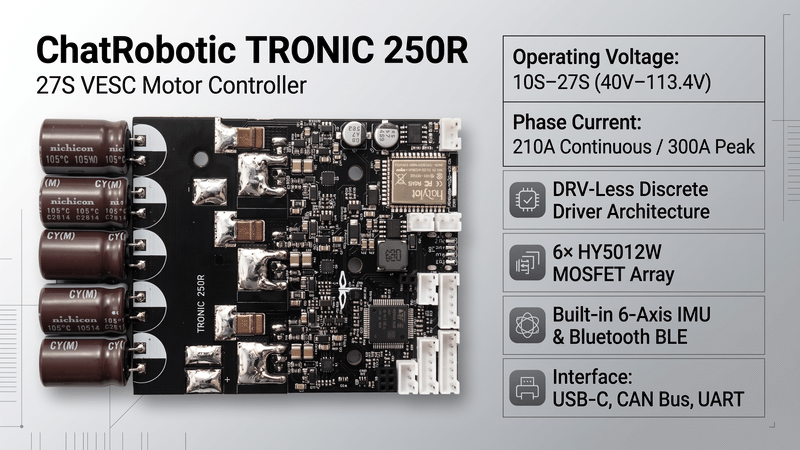
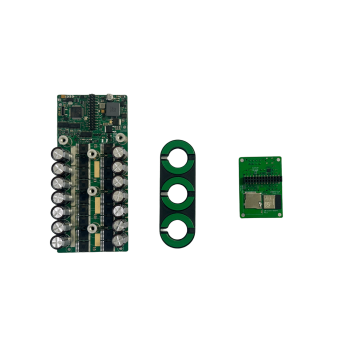
Quick Takeaway (TL;DR): The ChatRobotic TRONIC 250R is an entry-level, high-reliability 26S VESC motor controller delivering 210A continuous (with liquid/efficient cooling) and 300A peak (10 s) phase current for 10S–27S (up to 113.4V) systems. Engineered with an EV-derived DRV-less power stage, 6× HY5012W MOSFETs, integrated 6-axis IMU, built-in Bluetooth, and USB-C programming, it brings industrial-grade FOC motion control to light electric vehicles, AGVs, and test benches starting from $150.
1. Engineering Architecture & DRV-Less Power Stage Design
Most traditional open-source VESC designs rely on integrated gate driver ICs (such as the DRV8301/DRV8302 series). While convenient for low-voltage hobby electronics, integrated DRV chips are notoriously vulnerable to high-voltage inductive spikes, charge-pump degradation, and ground-bounce faults during rapid current switching.
Power Stage & Architecture Overview:
•DC Bus Input (10S–27S, 40V–113.4V)
•Heavy-Duty DC-Link Electrolytic & Ceramic Filtering Array
•4× DC-Link Copper Weight Bus Routing
•Discrete Logic & Control Layer
•Primary STM32 MCU Core (FOC Vector Calculation @ 25kHz–50kHz)
•Discrete Gate Driver Circuitry (DRV-Less Robust Architecture)
•Integrated 6-Axis Attitude IMU Sensor
•Integrated Bluetooth Transceiver (Mobile VESC Tool Support)
•Modern USB-C Configuration & Firmware Interface
•Power Stage Output
•6× HY5012W High-Current Power MOSFETs
•3-Phase Phase Lead Terminals (Up to 300A Peak / 210A Continuous Phase Output)
The TRONIC 250R replaces vulnerable integrated driver chips with an EV-derived DRV-less discrete gate driver topology:
•Immunity to Gate-Driver Latch-Up: Discrete driver networks eliminate common silicon substrate parasitic latch-ups, preventing premature controller failure caused by inductive kickback.
•Triple-Weight Copper Trace Construction: Built on a 2-layer layout utilizing ×3 copper thickness with 4× localized DC-link copper bus reinforcing, minimizing internal trace heating and resistive voltage sag.
•Calculated Thermal Conduction Loss: Conduction Loss (W) = 3 × (I_rms)^2 × R_ds(on) Where R_ds(on) represents the static channel resistance of the 6× HY5012W MOSFET array at operating temperature.
If you are evaluating how the 250R compares against high-power 600A–2000A controllers across the entire ecosystem, consult the complete 2026 VESC buyer's guide.
2. Electrical Specifications & Performance Parameters
The TRONIC 250R is engineered for 26S builds requiring dependable current delivery without the expense of extreme-duty multi-MOSFET arrays.
| Engineering Parameter | Specification (TRONIC 250R 125V (27S) 300A) | Practical Engineering Impact |
| Operating Voltage | 10S – 27S Battery (40.0V to 113.4V Peak) | Wide input compatibility spanning 36V, 48V, 72V, and 96V nominal packs. |
| Continuous Current | 210A (Efficient / Liquid Cooling) | Sustained thermal current capability for standard commuting and traction. |
| Peak Current (10 s) | 300A Phase Current | Breakout acceleration torque and obstacle traversal headroom. |
| Power Stage Topology | DRV-Less Discrete Driver + 6 × HY5012W | Eliminates gate driver IC failure modes under severe switching noise. |
| PCB Layer Structure | 2-Layer with ×3 Copper (4× DC-Link Weight) | Lower internal trace resistance and superior thermal spreading. |
| Control Modes | FOC (Field-Oriented Control) & BLDC | Smooth, quiet sine-wave torque control with trapezoidal fallback. |
| Max ERPM | 150,000 ERPM | Accommodates high-pole outrunner and mid-drive motor commutation speeds. |
| Thermal Protection | 75°C (Start Roll-back) to 95°C (Hard Cutoff) | Automatic current throttling protects MOSFET junction integrity. |
| Connectivity | USB-C, CAN Bus, Integrated Bluetooth, UART, ADC | Direct modern configuration, wireless telemetry, and multi-node sync. |
| Integrated IMU | Onboard 6-Axis Motion Sensor | Supports attitude sensing and basic balancing algorithms. |
| Throttle Interface | ADC (0–3.3V, 5V Tolerant), PPM, CAN, UART | Native compatibility with standard Hall-effect twist and thumb throttles. |
| Package Weight | 0.40 kg | Compact, lightweight footprint for tight chassis integration. |
| SKU & List Price | SKU: CRP00329 | List price from $150 (regularly $299). |
Specifications verified from ChatRobotic factory production sheets. Verify current stock at purchase.
3. Direct Hardware Benchmark: TRONIC 250R vs. X12 PRO vs. SEVEN 18
Understanding when to choose the budget-optimized TRONIC 250R versus higher-tier ChatRobotic hardware prevents overspending while ensuring adequate current headroom.
| Feature / Metric | TRONIC 250R | TRONIC X12 PRO | SEVEN 18 |
| Peak Current (10 s) | 300A | 662A (26S) / 380A (32S) | 993A (26S) / 792A (32S) |
| Continuous Current | ~210A (Active Cooling) | ~463A (26S Liquid) | ~695A (26S Liquid) |
| Max Voltage (S-Rating) | Up to 27S (113.4V) | Up to 26S / 32S (134.4V) | Up to 26S / 32S (134.4V) |
| MOSFET Array | 6 × HY5012W | 12 × Infineon TOLT | 18 × Infineon TOLT |
| Driver Topology | Discrete DRV-Less | Integrated Smart Drivers | Integrated Smart Drivers |
| Built-in IMU & Bluetooth | Yes | Yes (ESP32-C3) | Yes (ESP32-C3) |
| Programming Port | USB-C | USB-C / Micro | USB-C / Micro |
| Starting Price | from $150 | from $299 | from $450 |
| Best Suited Applications | Ebikes, Scooters, Light AGVs | Dual Eskate, Racing PEV, EUC | Onewheel, Extreme Torque PEV |
| Direct Product Link | TRONIC 250R Details | TRONIC X12 PRO Details | SEVEN 18 Details |
•Need a mid-range performance step-up? Read our in-depth TRONIC X12 PRO 26S vs. 32S Review.
•Need maximum power density for self-balancing builds? Read our SEVEN 18 VESC Review and Build Guide.
•Looking for ultra-high-power industrial drives (1000A–2000A)? Browse the full ChatRobotic VESC Motor Controllers Catalog.
4. Real-World Engineering Use Cases & Build Integration
The TRONIC 250R delivers the core advantages of open-source FOC control—silent operation, precise torque mapping, and regenerative braking—at an entry-level cost structure.
Application Matching Breakdown:
•26S E-Bikes & Commuter Scooters (1kW–5kW Powertrains)
•S-Rating: 10S to 26S (36V–96V Nominal)
•Advantage: Smooth FOC throttle ramp, regenerative braking, ADC Hall-throttle support
•Autonomous Mobile Robots & Industrial AGVs
•Control: Isolated CAN-Bus node integration, real-time current telemetry
•Advantage: Precise low-speed torque vectoring and position tracking
•Educational Labs & First-Time DIY FOC Platforms
•Architecture: Rugged DRV-less layout protects against beginner commissioning errors
•Advantage: USB-C and Bluetooth eliminate complex programming adapters
1. 26S High-Efficiency E-Bike Conversions
•Powertrain Architecture: Mid-drive or rear hub motor (e.g., 6354/6374 outrunner or geared hub) paired with a 48V–96V battery pack.
•Engineering Setup: Configure the analog ADC input for linear 0–3.3V throttle response. Enable regenerative braking to capture kinetic energy on descents while reducing mechanical brake wear.
•Thermal Plan: For sustained climbs above 2 kW, thermally couple the controller base to the bike frame using thermal interface material (TIM).
2. Commuter Kick Scooters & Urban PEVs
•Powertrain Architecture: Single or dual hub motors running on 10S to 13S packs.
•Engineering Setup: Use the integrated Bluetooth module for mobile tuning via VESC Tool. The optional external latching ON/OFF switch simplifies enclosure integration without bulky external contactors.
3. Light Robotics, AGVs & Research Test Benches
•Powertrain Architecture: Dual-wheel differential drive or conveyor actuator nodes linked over CAN bus.
•Engineering Setup: Map multi-node telemetry over CAN to an onboard companion computer (ROS/ROS2). The integrated 6-axis IMU supplies secondary chassis vibration and incline feedback directly over the data bus.
4. Electric Skateboard & Balancing Platform Considerations
•DIY E-Skateboards: While the 250R can drive entry-level street boards, aggressive dual-motor off-road setups requiring heavy launch torque should follow our VESC Electric Skateboard DIY Build Guide and consider the X12 PRO.
•Self-Balancing / Onewheel Builds: The onboard IMU supports basic balancing algorithms. However, high-speed single-wheel builds demanding massive burst recovery current should follow the VESC Onewheel Upgrade and Customization Guide and select the SEVEN 18.
5. VESC Tool Setup, Commissioning & ChatRobotic Manufacturing
Commissioning Sequence:
•Step 1: Pre-charge Verification & Low-Current Supply Connection (1.0A Limit)
•Step 2: Modern USB-C Connection to Desktop VESC Tool (or BLE Mobile)
•Step 3: FOC Motor Wizard Auto-Detection (Resistance R, Inductance L, Flux Lambda)
•Step 4: Motor & Battery Current Ceiling Configuration (<= 300A Phase / 200A Bus)
•Step 5: Thermal Rollback Configuration (75°C Start / 95°C Hard Cutoff)
•Step 6: ADC Throttle Voltage Mapping & 5% Deadband Verification
Step-by-Step Commissioning Protocol
1. Safe Power-Up: Connect the 250R to a current-limited DC bench power supply or utilize an anti-spark connector to prevent capacitive inrush surges.
2. Firmware Connection: Connect a standard USB-C cable directly to your PC. Open VESC Tool to establish instant connection without specialized driver installations.
3. FOC Motor Detection: Run the automated FOC Motor Detection Wizard to calculate motor stator resistance (R), inductance (L), and flux linkage (Lambda).
4. Current & Thermal Protection: Set
Motor Current Maxto match motor phase limits (up to 300A). SetMOSFET Temp Cutoff Startto 75°C andMOSFET Temp Cutoff Endto 95°C to ensure smooth thermal derating under heavy loads.5. Throttle Calibration: Navigate to
App Settings->ADC. Map minimum (0.8V–1.0V) and maximum (3.0V–3.3V) throttle voltages, ensuring a 5% deadband is active.
Turnkey OEM/ODM Engineering & PCBA Manufacturing
ChatRobotic supports volume integrators and enterprise engineers with end-to-end motor control solutions:
•Custom Firmware & Scripting: Pre-configured VESC firmware images with locked profiles, custom CAN message matrices, and custom throttle curves.
•Industrial Enclosure Machining: Rapid CNC prototyping of aluminum heatsinks, custom mounting brackets, and sealed IP67 enclosures.
•NDAA-Compliant Electronic Manufacturing: Certified ISO9001/14001 manufacturing facilities ensuring transparent supply chain tracking and non-restricted semiconductor components.
•Powertrain Ecosystem Matching: Seamless compatibility with ChatRobotic LandDrive (traction), AirDrive (aerial), and SeaDrive (marine) motor lineups.
Frequently Asked Questions (FAQs)
Q1: Is the TRONIC 250R suitable for high-performance electric skateboards?
A: The TRONIC 250R works well for lightweight, single or dual-motor commuter electric skateboards. However, performance mountainboards or high-speed racing builds that pull massive burst currents during hard acceleration should step up to the TRONIC X12 PRO (662A peak) or SEVEN 18 (993A peak).
Q2: What are the engineering benefits of a DRV-less VESC design?
A: Standard integrated gate driver chips (like the DRV8301) can fail when exposed to high-voltage inductive spikes, ground bounce, or excessive gate capacitance. The DRV-less discrete gate driver design on the TRONIC 250R uses discrete, robust switching components that tolerate electrical noise and transient spikes, resulting in significantly higher hardware reliability.
Q3: Can the TRONIC 250R operate on a 32S (134.4V) battery pack?
A: No. The TRONIC 250R is strictly rated for up to 27S Li-ion packs (113.4V maximum peak). Connecting a 32S battery (134.4V fully charged) will exceed the maximum voltage ratings and destroy the power stage. For 32S platforms, select the 32S variant of the TRONIC X12 PRO or SEVEN 18.
Q4: Can I configure and tune the TRONIC 250R wirelessly from a smartphone?
A: Yes. The TRONIC 250R includes an onboard Bluetooth transceiver. By opening the mobile VESC Tool app on iOS or Android, you can monitor live motor telemetry, adjust throttle curves, and configure FOC limits wirelessly without connecting a physical cable.
Q5: What is the continuous current rating of the TRONIC 250R under passive cooling?
A: The rated 210A continuous current assumes active liquid cooling or direct chassis conduction to a large aluminum heat sink. Under passive, still-air conditions inside a sealed enclosure, the continuous current should be de-rated to approximately 60A–80A depending on ambient temperature, relying on the 75°C–95°C thermal rollback protection.
Need Custom High-Power Powertrain Engineering?
Source the TRONIC 250R VESC Motor Controller, explore our complete ChatRobotic VESC Motor Controllers catalog, or get in touch with our engineering and hardware manufacturing team directly for custom CAD/STEP models, specialized 26S–32S+ power stages, and volume OEM/ODM inquiries: Contact ChatRobotic Engineering


{{ commentCount }} Comments