
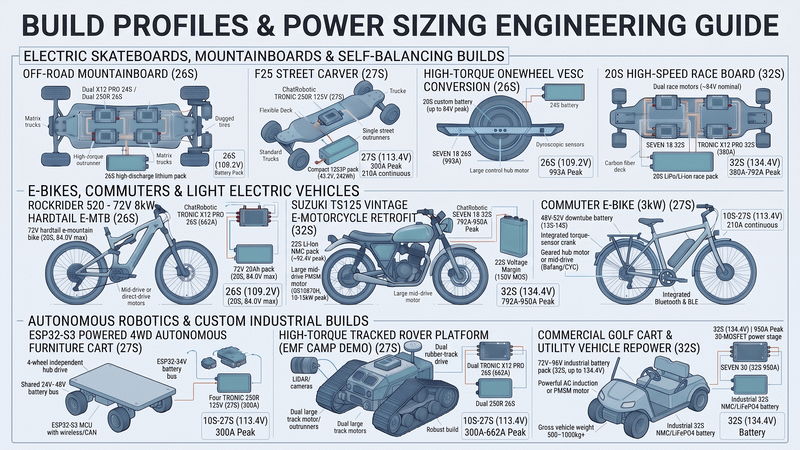
Quick Takeaway (TL;DR): Open-source VESC Field-Oriented Control (FOC) firmware provides the torque density, telemetry, and programmability required for ambitious electrification builds. From 12S urban carvers and 72V e-mountainbikes to self-balancing Onewheels and four-wheel-drive robotic platforms, matching the motor's phase-current demand, battery voltage (up to 32S / 134.4V), and onboard sensor requirements (such as 6-axis IMUs and CAN-bus telemetry) to commercial-grade hardware like the ChatRobotic TRONIC and SEVEN series eliminates power-stage failures and unlocks peak performance.
1. Electromechanical Demands Across High-Performance DIY Builds
Custom electrification projects push motor controllers beyond the limits of hobby-grade hardware. Standard closed-source ESCs rely on trapezoidal commutation and fixed current ceilings, leading to rough low-speed throttle response, high acoustic noise, and thermal shutdown under load. VESC-based Field-Oriented Control (FOC) decouples magnetic flux and torque vectors, allowing independent control of motor dynamics:
•Torque-to-Current Proportionality:
Torque (Nm) = K_t × I_phaseLow-speed hill climbing, heavy skid-steering, and rough-terrain launch demand massive phase current (I_phase) that often exceeds battery current by a factor of 3 to 5.•High-Speed Commutation Execution:
ERPM = Mechanical RPM × Motor Pole PairsHigh-pole-count outrunners and high-voltage battery packs must remain below the tracking limit of the microcontroller's observer loop to avoid loss of commutation synchronization.•Inductive Spike Management:
Spike Voltage (V) = V_bus + [L_loop × (di/dt)]Rapid MOSFET switching on 20S–32S battery leads creates high di/dt transients. Silicon voltage breakdown ratings (V_ds) must provide adequate safety headroom (such as 150V MOSFETs on 20S–32S systems) to absorb regenerative energy without MOSFET punch-through.
Powertrain Selection Sequence:
•Motion Dynamics Assessment
•Self-Balancing Motion: Requires direct onboard high-speed IMU with instantaneous 800A+ phase current headroom.
•Dual/Quad Synchronized Drivetrains: Requires multi-drop CAN bus architecture with matched discrete current stages.
•High-Voltage Traction (72V–134.4V): Requires 26S/32S silicon architecture (100V–150V MOSFETs) with heavy aluminum chassis heatsinking.
•Light Utility Mobility: Requires DRV-less discrete gate driver layout with linear 5V-tolerant ADC throttle input.
To master foundational electrical sizing and avoid common failure modes before beginning a build, explore the complete 2026 VESC buyer's guide.
2. Top 10 Community VESC Builds & ChatRobotic Hardware Sizing
Category A: Electric Skateboards, Mountainboards & Self-Balancing Builds
1. MBS X MBoards Off-Road Electric Mountainboard
•Build Architecture: Dual high-KV brushless outrunners (6384/6396), 12S–18S high-discharge lithium pack, deep-tread pneumatic tires for loose dirt and steep gravel climbs.
•Engineering Challenge: High rolling resistance and incline spikes demand dual-channel, massive low-end phase current without thermal saturation during extended throttle pulls.
•Recommended Hardware: Dual TRONIC X12 PRO 26S (662A) units synchronized over CAN bus (delivering 1,324A combined peak phase authority), or dual TRONIC 250R 125V (27S) (300A) for cost-effective, lightweight 12S–16S dual setups.
•Build Reference: Review our deep-dive TRONIC X12 PRO review and follow the step-by-step wiring guide in our dual-VESC eskate build guide.
2. F25 Street Carver (Electrium Mobility Style)
•Build Architecture: 12S2P compact pack (43.2V, 242Wh), single or dual street outrunners, ultra-slim under-deck enclosure.
•Engineering Challenge: Smooth, silent urban cruising with predictable regenerative braking in a lightweight envelope without gate-driver burnout.
•Recommended Hardware: TRONIC 250R 125V (27S) (300A) – Delivers 210A continuous current, modern USB-C programming, integrated Bluetooth, and a robust DRV-less power stage.
•Build Reference: Learn more about the discrete power stage in our TRONIC 250R review.
3. High-Torque Onewheel VESC Conversion
•Build Architecture: Onewheel XR/GT platform repowered with open-source balance firmware and custom battery configurations up to 20S (84V peak).
•Engineering Challenge: Self-balancing attitude loops require sub-millisecond IMU response and massive instantaneous phase-current headroom to prevent dangerous torque saturation (nosedives) when hitting bumps or transitions.
•Recommended Hardware: SEVEN 18 26S (993A) with built-in 6-axis IMU direct-bus interface and rugged CNC aluminum baseplate, or the TRONIC X12 PRO 26S (662A).
•Build Reference: Follow our Onewheel VESC upgrade & IMU calibration guide and technical breakdown in the SEVEN 18 review.
4. 20S High-Voltage Stooge SRB Race Board
•Build Architecture: 20S LiPo/Li-ion race pack (~84V nominal, 84V–88V peak), twin inrunner/outrunner motors geared for 50+ mph track speeds.
•Engineering Challenge: Extreme electrical RPM and massive inductive voltage spikes during high-speed regenerative braking that easily puncture standard 100V-rated MOSFETs.
•Recommended Hardware: SEVEN 18 32S (792A) or TRONIC X12 PRO 32S (380A), both featuring 150V MOSFETs and 160V auxiliary DC-DC converters for >60V transient headroom.
•Build Reference: Review the silicon voltage tradeoffs in the TRONIC X12 PRO 26S vs 32S review.
Category B: E-Bikes, Commuters & Light Electric Vehicles
5. Rockrider 520 – 72V 8kW Hardtail E-MTB Conversion
•Build Architecture: 72V 20Ah pack (20S, 84.0V max) paired with a direct-drive hub motor (MXUS 3K Turbo / QS205 class), set up for road and trail riding.
•Engineering Challenge: Smooth FOC sine-wave commutation, aggressive field weakening, and robust chassis heat dissipation under 110A+ battery current draws.
•Recommended Hardware: TRONIC X12 PRO 26S (662A) – The aluminum CNC base mounts directly to the frame for optimal thermal sinking. For budget 3kW–5kW builds, the TRONIC 250R 125V (27S) (300A) serves as an ultra-compact alternative.
•Build Reference: Select the right configuration in our best VESC by application guide.
6. Suzuki TS125 Vintage E-Motorcycle Retrofit
•Build Architecture: 22S Li-Ion NMC pack (~92.4V peak), high-torque PMSM mid-drive motor (QS138 70H/90H class, 10kW–15kW peak) linked to original chain drive. Total vehicle + rider payload >200kg.
•Engineering Challenge: Sustained high thermal current loads during highway cruising combined with severe inductive flyback voltage spikes upon sudden throttle releases.
•Recommended Hardware: SEVEN 18 32S (792A) with top-side cooled Infineon TOLT MOSFETs as the primary standard, or step up to the industrial SEVEN 30 150V (32S) 950A for continuous multi-kilowatt highway speed without thermal throttling.
•Build Reference: Compare platform capabilities in the three-model buyer's guide.
7. 500W–3000W High-Efficiency Commuter E-Bike
•Build Architecture: 48V–52V (13S–14S) downtube battery, geared hub motor or mid-drive (Bafang/CYC), integrated torque-sensor crank.
•Engineering Challenge: Reliable daily operation, silent FOC commutation, and linear regenerative braking with direct 5V analog throttle integration.
•Recommended Hardware: TRONIC 250R 125V (27S) (300A) – The DRV-less discrete power stage eliminates gate-driver IC burnout from hub-motor back-EMF spikes, with onboard BLE for smartphone tuning.
•Build Reference: Evaluate full specs in the complete VESC buyer's guide.
Category C: Autonomous Robotics & Custom Industrial Builds
8. ESP32-S3 Powered 4WD Autonomous Furniture Cart
•Build Architecture: 4-wheel independent hub drive running off a shared 24V–48V battery bus, commanded wirelessly by an ESP32-S3 MCU over CAN bus.
•Engineering Challenge: Coordinating smooth 4-wheel electronic differential speed and current control over a multi-node bus without wiring bottlenecks.
•Recommended Hardware: Four TRONIC 250R 125V (27S) (300A) units daisy-chained over CAN bus with distinct Node IDs.
•Build Reference: Read the interface specifications in our TRONIC 250R review.
9. High-Torque Tracked Rover Platform (EMF Camp Demo)
•Build Architecture: Dual rubber-track drive, 10S–16S battery, dual heavy outrunners geared for high reduction.
•Engineering Challenge: Massive static track friction during pivot/skid-steering causes near-stall current spikes exceeding 250A per side on rough terrain.
•Recommended Hardware: Dual TRONIC X12 PRO 26S (662A) for heavy-duty rovers (>35kg) to eliminate locked-rotor overcurrent trips, or dual TRONIC 250R 125V (27S) (300A) with Hall sensors for light-to-medium utility rovers.
•Build Reference: Explore low-speed hall sensor calibration in the TRONIC 250R review.
10. Commercial Golf Cart & Utility Vehicle 96V Repower
•Build Architecture: 72V–96V industrial battery pack (32S NMC / 32S LiFePO4, up to 134.4V), paired with an AC induction or high-pole PMSM traction motor. Total gross vehicle weight 500kg–1000kg+.
•Engineering Challenge: Extended, continuous high phase-current draw (300A–500A continuous) when pulling passenger loads up 15%+ inclines, requiring extreme thermal mass and busbar capacity.
•Recommended Hardware: SEVEN 30 150V (32S) 950A – Engineered with a 30-MOSFET power stage and heavy industrial thermal mass to sustain continuous multi-kilowatt traction loads without thermal rollback.
•Build Reference: Discover industrial high-power selection in the complete buyer's guide.
3. Hardware Architecture & Specification Benchmark
| # | Community Build Profile | Recommended ChatRobotic VESC | Voltage / Current Ratings | Key Engineering Asset | Product & Review Links |
| 1 | Off-Road Mountainboard | Dual X12 PRO 26S / Dual 250R 26S | 26S (109.2V) / (2 × 662A) or (2 × 300A) Peak | Dual-Drive CAN Sync & Massive Incline Phase Authority | X12 PRO Review · Eskate Guide |
| 2 | F25 Urban Street Carver | TRONIC 250R 125V (27S) | 10S–27S (113.4V) / 300A Peak | DRV-Less Layout & Slim Enclosure Fit | TRONIC 250R Review |
| 3 | Onewheel VESC Upgrade | SEVEN 18 26S (with case) | 26S (109.2V) / 993A Peak | Direct SPI 6-Axis IMU & 1000A Anti-Nosedive Headroom | Onewheel Guide · SEVEN 18 Review |
| 4 | 20S High-Speed Race Board | SEVEN 18 32S / X12 PRO 32S | 32S (134.4V) / 380A–792A Peak | 150V MOSFETs for High-Speed Regen Spike Protection | X12 PRO 26S vs 32S |
| 5 | 72V 8kW Hardtail E-MTB | TRONIC X12 PRO 26S | 26S (109.2V) / 662A Peak | CNC Aluminum Chassis Heat Sinking & Field Weakening | By-Application Guide |
| 6 | Suzuki Vintage E-Moto | SEVEN 18 32S / SEVEN 30 | 32S (134.4V) / 792A–950A Peak | 22S Voltage Margin (150V MOS) & High-Load S1 Duty | 3-Model Buyer's Guide |
| 7 | Commuter E-Bike (3kW) | TRONIC 250R 125V (27S) | 10S–27S (113.4V) / 210A Cont. | Integrated Bluetooth & 5V-Tolerant ADC Throttle | Complete Buyer's Guide |
| 8 | ESP32 4WD Cart | TRONIC 250R 125V (27S) (x4) | 10S–27S (113.4V) / 300A Peak | Multi-Drop CAN-Bus Differential Architecture | TRONIC 250R Review |
| 9 | Tracked All-Terrain Rover | Dual X12 PRO 26S / Dual 250R 26S | 10S–27S (113.4V) / 300A–662A Peak | High Locked-Rotor Skid-Steering Phase Headroom | TRONIC 250R Review |
| 10 | 96V Utility Cart Repower | SEVEN 30 150V (32S) 950A | 32S (134.4V) / 950A Peak | 30-MOSFET Continuous High-kW Industrial Traction | Complete Buyer's Guide |
Browse the full lineup: ChatRobotic VESC Motor Controllers.
4. Commissioning Workflows, Thermal Planning & Common Traps
Universal VESC Commissioning Workflow:
•Step 1: Bench Safety Verification
•Perform pre-charge verification.
•Bench power-up using a current-limited DC supply (1.0A limit).
•Step 2: Automated FOC Parameter Identification
•Execute FOC Wizard for phase resistance (R), phase inductance (L), flux linkage (Lambda), and Hall/Encoder offset detection.
•Step 3: Application-Specific Sensor & Interface Mapping
•Balancing Builds: 6-Axis IMU calibration, SPI bus verification, and attitude PID loop configuration.
•Dual/Multi-Drive Builds: Master/Slave CAN ID assignment, baud rate check, and remote pairing.
•E-Bikes & Utility Builds: 5V-tolerant ADC throttle voltage mapping with a 5% safety deadband.
•Step 4: Current Ceiling & Thermal Cutoff Configuration
•Configure motor/battery current limits.
•Set thermal rollback thresholds: soft throttling starting at 75°C, hard current cutoff at 95°C.
Critical Engineering Traps to Avoid
1. Sizing by Battery Current Rather Than Phase Current: Phase current generates physical torque. Setting phase limits equal to battery limits results in weak low-end torque and poor hill-climbing authority.
2. Ignoring Regenerative Voltage Spikes: Aggressive braking on a fully charged battery forces current back into the bus:
Spike Voltage (V) = V_bus + [L_loop × (di/dt)]. Ensure your controller's silicon breakdown rating (such as 150V MOSFETs on 32S models) provides adequate margin above battery charge limits.3. Passive Thermal Saturation: Operating above 150A continuous in sealed enclosures without chassis conduction leads to rapid thermal throttling. Always mount the controller's aluminum baseplate flat against an external aluminum heat sink using high-conductivity thermal gap pads (conductivity >= 6.0 W/m·K).
5. Turnkey Powertrain Integration & ChatRobotic Manufacturing
Building production-ready mobility or robotic systems requires bridging the gap between open-source flexibility and commercial manufacturing standards. ChatRobotic delivers end-to-end powertrain engineering:
•Integrated Motor Ecosystem: Native mechanical and electrical compatibility with ChatRobotic LandDrive (traction/direct-drive), AirDrive (aerial propulsion), and SeaDrive (marine thrusters).
•NDAA-Compliant Electronic Manufacturing: Certified supply chains free of restricted telecommunications and semiconductor components, suitable for commercial robotics, aerospace, and defense applications.
•Custom Firmware & Communication Stacks: Customized VESC firmware forks featuring proprietary CAN message sets, custom throttle response curves, and industrial safety interlocks.
•Turnkey PCBA & CNC Enclosure Services: ISO9001/14001 certified facilities offering rapid SMT prototyping, custom CNC aluminum machining, and IP67 sealed enclosure production.
Frequently Asked Questions (FAQs)
Q1: Can I replace a stock e-bike or scooter controller with a VESC controller?
A: Yes. A VESC controller provides a major upgrade over stock block-commutation controllers by offering smooth Field-Oriented Control (FOC), customizable acceleration curves, programmable regenerative braking, and mobile telemetry via Bluetooth. The TRONIC 250R is an ideal drop-in replacement supporting 8S to 26S packs with 5V-tolerant ADC throttle inputs.
Q2: Why is an integrated IMU critical for Onewheel and self-balancing conversions?
A: Self-balancing platforms require real-time pitch, roll, and angular velocity data to calculate motor torque corrections hundreds of times per second. Controllers like the SEVEN 18 and TRONIC X12 PRO feature onboard 6-axis IMUs connected directly to the primary microcontroller, eliminating the wiring complexity and latency of external sensor boards.
Q3: How do two VESC controllers synchronize in a dual-motor electric skateboard?
A: Dual VESC controllers communicate over an isolated CAN-bus connection. One unit is designated as the Master (receiving throttle input from the remote receiver and executing motor control for side A), while transmitting synchronized torque commands over CAN to the Slave controller (driving side B) with microsecond latency.
Q4: When is a 32S-rated controller required over a 26S model?
A: A 26S controller operates up to a maximum voltage of 109.2V DC. If your battery configuration uses 20S LiPo race packs (with extreme regenerative di/dt spikes) or 22S to 32S Li-ion cells (operating up to 134.4V fully charged), you must select a 32S-rated controller—such as the SEVEN 18 32S, TRONIC X12 PRO 32S, or industrial SEVEN 30—to provide the 150V silicon breakdown headroom needed to withstand inductive voltage spikes without avalanche breakdown.
Q5: Can ChatRobotic manufacture custom VESC controllers for commercial OEM projects?
A: Yes. ChatRobotic operates ISO9001/14001 certified manufacturing facilities, providing custom PCB layouts, customized CNC billet enclosures, NDAA-compliant component sourcing, application-specific firmware adaptations, and custom CAN communication protocols for commercial robotics, e-mobility, and defense applications.
Need Custom High-Power Powertrain Engineering?
Explore the complete ChatRobotic VESC Motor Controllers catalog, or get in touch with our engineering and hardware manufacturing team directly for custom CAD/STEP models, specialized 26S–32S+ power stages, and volume OEM/ODM inquiries: Contact ChatRobotic Engineering


{{ commentCount }} Comments