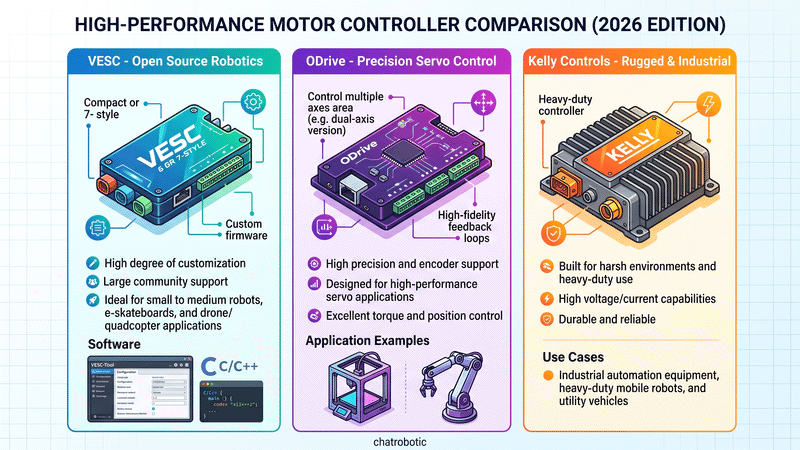
The world of open-source motor control has never been more exciting. VESC, ODrive, and Kelly represent three distinct philosophies of motor control, each excelling in different domains. This guide breaks down their core differences, performance metrics, and ideal use cases so you can make an informed decision for your 2026 project.
Quick Answer: Which Motor Controller Should You Choose?
•Choose VESC if you are building e-skateboards, e-bikes, scooters, rovers or RC vehicles and you want open firmware you can tune down to the last parameter.
•Choose ODrive if you need precision position control — robot arms, CNC axes, pick-and-place, gimbals — and want dual-axis servo control on one board.
•Choose Kelly if you need 200A+ continuous current for a commercial or utility EV and want proven reliability rather than deep customization.
The rest of this guide explains why, with a full specification table and the trade-offs behind each recommendation.
The Big Picture: Three Different Worlds
VESC, ODrive, and Kelly serve fundamentally different audiences:
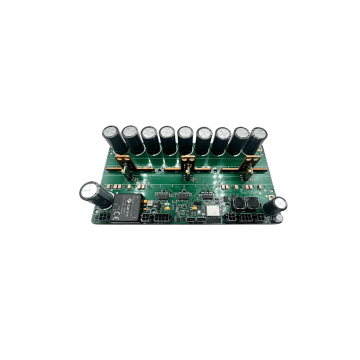
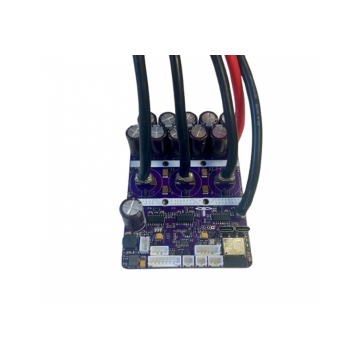
•VESC – The DIY champion. Open-source firmware running on hardware from dozens of manufacturers. Perfect for electric skateboards, e-bikes, scooters, and light EVs.
•ODrive – Precision specialist. Designed for robotics, CNC machines, and applications demanding exact position control.
•Kelly – Industrial workhorse. Built for heavy-duty EVs, commercial vehicles, and off-road applications where reliability trumps customization.
2026 Specifications: Head-to-Head
| Feature | VESC | ODrive | Kelly |
| Primary Focus | Electric vehicles, e-skateboards, general BLDC | Industrial robotics, precision positioning | Heavy-duty EVs, commercial vehicles |
| Voltage Range | 3V – 100V+ (multi-vendor) | 12V – 56V (V3.6) | 24V – 144V (KLS series, model-dependent) |
| Continuous Current | 50A – 250A+ (hardware dependent) | 40A – 90A per channel (cooling-dependent) | 240A – 600A |
| Peak Current | Hardware-dependent | 120A per motor | 600A+ |
| Control Modes | Torque, Speed, (limited Position) | Torque, Speed, Position (full 3-loop) | Torque, Speed, Regenerative Braking |
| Encoder Support | Hall, ABI, AS5047, etc. | Incremental, Absolute, SPI | Hall sensors (primary) |
| Communication | CAN, USB, UART, PPM, ADC | CAN, UART, SPI, USB | CAN, USB, RS232 |
| Open Source? | Full hardware + firmware | Firmware only (PCB closed) | Commercial product |
| Entry Price | ~$150 | ~$200 | $500+ |
The short version: VESC trades specialization for flexibility, ODrive trades flexibility for precision, and Kelly trades flexibility for current handling and durability.
Voltage and current figures verified against vendor specifications in September 2026: ODrive v3.6 is rated 12V–56V input with 120A peak per motor and 40–90A continuous per channel depending on cooling (ODrive product specifications); Kelly's KLS sinusoidal series spans roughly 24V–144V depending on model (Kelly Controls).
Deep Dive: What Each Does Best
VESC: The Open-Source Community Champion
VESC began in 2015 as an open-source project for electric skateboards and has grown into a versatile ecosystem powering everything from e-foils to full-size EVs. Its firmware and tooling are maintained in the open by the VESC Project, with the source available in the bldc firmware repository.
Strengths:
•Massive community support and hardware options
•Advanced FOC for silent, smooth low-speed operation
•Excellent regenerative braking implementation
•VESC Tool provides unified configuration and telemetry
Weaknesses:
•Position control requires external sensors and tuning
•Quality varies across third-party hardware
If you want the technical background on how the platform is built, see VESC: the open-source FOC motor driver. For the tuning side, Mastering VESC Tool: firmware and FOC tuning walks through the parameters that matter, and FOC smoothness and regenerative braking explains why the low-speed feel is so distinctive.
"Nearly all PEVs are running their own version of VESC as the primary motor controller." — DIY builder community
ODrive: Precision Perfected
ODrive focuses on one thing: high-precision servo control. Its dual-channel design and high-bandwidth current loop (20kHz+) make it the go-to for robotics. Configuration runs through the vendor's own toolchain, documented at the ODrive documentation, with the product range on the ODrive site.
Strengths:
•Native dual-motor control on a single board
•Sub-0.1° positioning accuracy with encoders
•S-curve trajectory planning for smooth motion
•Python-based ODrivetool for debugging
Weaknesses:
•Higher cost than entry-level VESC
•Newer PCBs are closed-source (no clones)
•Overkill for simple propulsion tasks
If your interest is motion control rather than propulsion, the same design goals show up in VESC in robotics and AGV platforms, and dual-axis work has a VESC-side equivalent in dual-motor VESC setups.
Kelly: Industrial Reliability
Kelly controllers are battle-tested in commercial EVs, golf carts, and material handling equipment. The KLS series delivers sinusoidal control across a wide voltage range. Specifications and models are published by Kelly Controls.
Strengths:
•Massive current handling (600A+ peak)
•Aluminum PCBs for superior heat dissipation
•Manufacturer-rated efficiency up to 99% (SVPWM + FOC)
•Proven reliability in harsh environments
Weaknesses:
•Closed-source, limited community support
•Less tuning flexibility than VESC
•Higher entry cost
For builders working at Kelly-level voltages on the VESC side, 72V electric motorcycle build notes and calculating battery current and power cover the sizing math that matters at 200A+ continuous.
2026 Verdict: Which Motor Controller Wins?
| Choose VESC if... | Choose ODrive if... | Choose Kelly if... |
| You're building e-skateboards, e-bikes, scooters, or rovers | You need precision positioning for robot arms or CNC | You need 200A+ continuous for commercial EVs |
| You value open-source flexibility and community support | You want plug-and-play dual-axis servo control | Reliability matters more than customization |
| Regenerative braking is important | High bandwidth at zero speed is required | You're working with 72V+ systems |
| Budget is a consideration | You're willing to pay for industrial-grade servo performance | You need proven off-road durability |

Quick Decision Flowchart
Start with your primary requirement:
•Propulsion-focused (e-bike, skateboard, scooter, RC car) → VESC
•Precision-focused (robot arm, CNC, pick-and-place) → ODrive
•Heavy-duty EV (golf cart, utility vehicle, 200A+ sustained) → Kelly
How to Choose: Matching the Controller to Your Build
Across all three platforms, three numbers decide whether a controller fits — and none of them should come from a peak figure on a spec sheet:
1. Pack voltage. Match the controller's input window to your fully charged pack, with headroom. This alone rules Kelly in or out for most high-voltage projects.
2. Continuous current. Use the current your motor actually draws during sustained operation. Kelly's advantage is here; VESC covers the same ground with the right hardware choice.
3. Control requirement. If you need position, ODrive's native 3-loop control saves you integration work. If you need torque and speed with deep tuning, VESC is the more flexible base.
If the answer points to VESC, the practical next step is sizing: the VESC controller buyer's guide covers the full range, how to choose a VESC motor controller walks through the decision, and best VESC controller by application maps controllers to specific vehicle types. Building an RC platform rather than a PEV? The VESC RC car guide covers that end of the spectrum.
VESC vs ODrive vs Kelly FAQ
Q: Can I use VESC for precision robotics? A: Yes, but you'll need external encoders and accept that its position control is less refined than ODrive's.
Q: Is ODrive good for e-skateboards? A: It works, but VESC is more common due to better regenerative braking tuning and lower cost.
Q: Can Kelly replace VESC on a DIY e-bike? A: Absolutely. You'll trade deep customizability for robust, out-of-the-box power delivery.
Q: Which is cheapest for a first project? A: VESC. Entry-level single controllers start around $150, while turnkey ODrive units start higher and Kelly's industrial range sits above both.
Q: Where does Kelly shine compared to the others? A: Kelly dominates where current demands exceed 200A continuous — mid-size EVs and heavy utility projects — thanks to its aluminium PCB construction and wide voltage range.
Q: Which controller is best for an e-skateboard build? A: VESC. Sensored FOC startup, tunable regenerative braking and a large hardware ecosystem make it the default choice. Start with a VESC electric skateboard build guide.
Q: Does ODrive support dual motors? A: Yes — dual-channel control on a single board is one of its defining features. VESC matches this with two controllers linked over CAN bus, which is covered in the dual-motor VESC guide.
Q: Which platform is best for autonomous vehicles? A: It depends on the layer you need. VESC exposes motor-derived odometry and ROS integration for actuation; ODrive is the stronger pick for precise multi-axis motion. See VESC's odometry and ROS integration for the propulsion-side view.
The 2026 Outlook
The VESC ecosystem continues to expand with new hardware like the VESC-LS series pushing 200A+ continuous. ODrive remains the benchmark for precision, with active firmware development. Kelly retains its industrial stronghold, though open-source alternatives are slowly eating into lower-power segments.
Final take: For the large majority of DIY builders, VESC is the sweet spot — powerful enough, affordable, and backed by an active community. ODrive serves the robotics niche precisely. Kelly is your choice when only raw industrial current will do.
If your project needs more than an off-the-shelf controller, browse the full VESC motor controller lineup — ranges run from 57V (14S) to 150V (32S) and 300A to 2,376A peak — or contact our engineering team for custom CAD/STEP models, specialized 26S–32S+ power stages, and volume OEM/ODM inquiries.
Sources: Specification and feature data compiled from VESC Project and the bldc firmware repository; ODrive documentation and the ODrive v3.6 specification page; Kelly Controls. ChatRobotic hardware figures from factory specification sheets. Figures accessed September 2026 — confirm against each vendor's current datasheet before purchase.


{{ commentCount }} Comments