
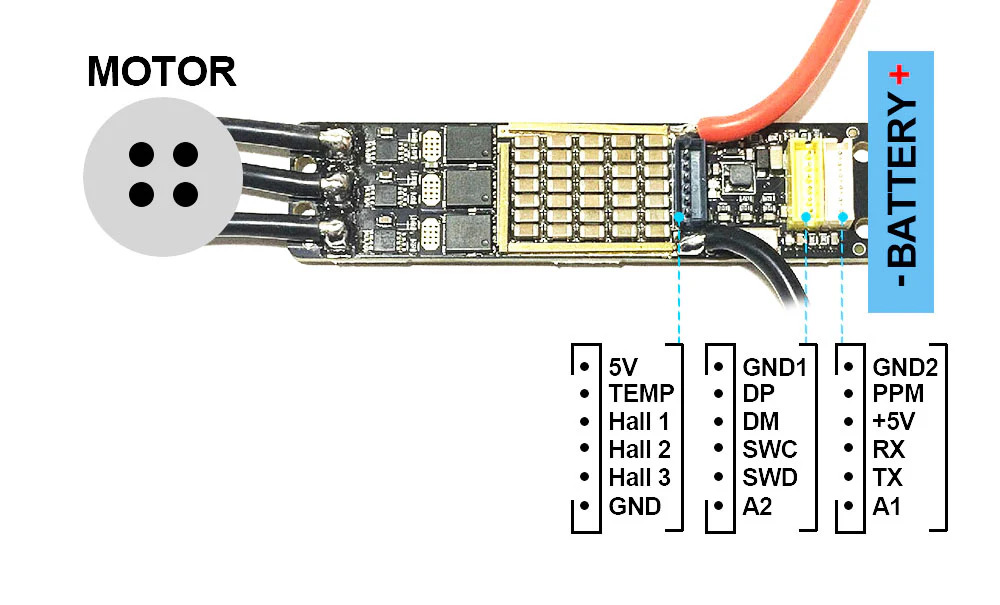
Most RC enthusiasts know the frustration of a great build held back by a mediocre ESC. Chattering at low speed, cogging from a standstill, and limited tuning options are all too familiar. The VESC (Vedder Electronic Speed Controller) changes the game entirely. Originally designed for electric skateboards, this open-source controller has found a passionate following in the RC world — and for good reason.
Why VESC Outperforms Traditional RC ESCs
Standard RC ESCs, even high-end sensored models from brands like Castle Creations or Hobbywing, are closed systems. You get the tuning options the manufacturer decided to give you, and nothing more. VESC is fundamentally different. It's an open platform that gives you access to every parameter that affects how your motor performs.
The difference is most noticeable in two areas that matter most to serious RC builders: sensored motor precision and Field-Oriented Control (FOC) smoothness.
Sensored Control: The Foundation of Precision
For 1/5 scale vehicles and crawlers, sensored motors are non-negotiable. Hall effect sensors inside the motor provide precise rotor position feedback to the ESC, delivering buttery-smooth low-speed control that's essential for rock crawling and technical trail driving.
VESC fully supports sensored motors and makes it easy to configure them through the motor setup wizard. The VESC Tool software allows selection between Hall sensors and sensorless operation, with Hall sensors offering more precision and smoother startup at low speeds.
FOC: The Smoothness Revolution
Field-Oriented Control is the primary motor control method in VESC firmware. Unlike the block commutation used by most RC ESCs, FOC treats motor currents as independent vectors, enabling precise control at every speed.
The results are dramatic. FOC delivers a much smoother performance at lower speeds compared to traditional controllers, with faster step response and more efficient use of current. Motor noise is significantly reduced, and torque delivery is linear and predictable. For crawlers that need to inch over obstacles at walking pace, this smoothness transforms the driving experience.
When you combine sensored motors with FOC, you get the best of both worlds: silky smooth startup from zero RPM and whisper-quiet operation across the entire speed range.
VESC for 1/5 Scale: Power Where It Counts
1/5 scale RC cars are the giants of the hobby. They're heavy, powerful, and demand serious hardware. Traditional ESCs for this scale are expensive and still limited in their tuning capabilities.
VESC controllers scale up effortlessly. The VESC ecosystem includes models capable of handling 300A and 100V, running full FOC sinusoidal motor control. This is more than enough grunt for even the most extreme 1/5 scale builds.
For heavy-duty off-road applications, sensored brushless outrunners in the 3650, 3660, or 4274 size range paired with 300-800KV motors on 3S-4S batteries are a proven combination. The VESC's auto-detection of motor parameters means you don't need to be an electrical engineer to get the setup right.
VESC for Crawlers: Precision at Walking Pace
Rock crawlers demand the most from their ESCs. Starting from a dead stop on a steep incline, inching over obstacles, and maintaining control at near-zero speed separate a great ESC from a mediocre one.
VESC excels in exactly these conditions. FOC provides such smooth low-speed control that VESC delivers consistent, predictable torque even at the lowest speeds.
For crawler builds, sensored brushless outrunners with 4 poles or more are recommended. The VESC's hall sensor support ensures smooth startup from 0 RPM, while FOC maintains that smoothness throughout the speed range.
Crawler-Specific Tuning
VESC Tool gives crawler builders access to parameters that traditional ESCs hide away. You can fine-tune throttle curves, ramp times, and current limits to achieve the exact crawling feel you want. The PPM application in VESC firmware supports multiple control types including current control with brake and reverse, with hysteresis for smooth transitions.
Some crawler builders also use drag brake functionality, where the motor holds position on inclines. VESC's regenerative braking and current control make this easy to configure.
Beyond the Basics: What VESC Unlocks
Odometry Without Extra Sensors
One of VESC's hidden strengths for RC applications is its ability to use the motor itself as a tachometer. This provides valuable odometry data without needing additional sensors — ideal for autonomous RC cars or any build where precise positioning matters.
ROS and Autonomous Integration
For builders working on autonomous RC platforms, VESC integrates seamlessly with ROS (Robot Operating System). A ROS node running on a Raspberry Pi can send time-stamped velocity and steering profiles to the VESC, enabling sophisticated autonomous control.
Dual Motor and 4WD Control
VESC supports CAN bus communication between multiple controllers, enabling sophisticated dual-motor and 4WD setups. Builders have successfully used VESC for vector thrusting with two motors and IMU-based stabilization.
Traction Control
The VESC firmware includes traction control features that can be enabled through the PPM application, offering advanced traction management for challenging terrain.
Getting Started with VESC for RC
Choose Your Hardware
VESC-based controllers are available from multiple manufacturers. The VESC 6 EDU is a great entry point, limited to 6S and around 50A peak, making it suitable for smaller RC cars and robotics. For higher power, options like the Flipsky FSESC6.6, MakerX DV6S, or 3Shul controllers provide the current handling needed for 1/8 and 1/5 scale builds.
Configure with VESC Tool
VESC Tool is the official configuration software, available for desktop and mobile platforms. The setup process follows a clear sequence:
1. Run the Motor Setup Wizard — This auto-detects motor parameters including resistance, inductance, and flux linkage. For sensored motors, ensure hall sensors are enabled.
2. Configure the PPM Application — This interprets signals from your RC receiver. Settings include control type (current, duty cycle, or PID), pulse width ranges, ramp times, and throttle curves.
3. Set Current and Voltage Limits — Protect your hardware by configuring appropriate limits for your battery and motor.
4. Fine-Tune — Adjust throttle curves, braking strength, and other parameters to match your driving style.
Test and Iterate
Start with conservative settings and gradually increase limits while monitoring motor and controller temperatures. The real-time data available through VESC Tool makes it easy to see exactly what your system is doing.
The Verdict
VESC represents a fundamental shift in what's possible with RC motor control. For 1/5 scale builders, it delivers the power and tuning depth that big cars demand. For crawler enthusiasts, it provides the silky smooth low-speed control that makes technical driving a joy. And for anyone building autonomous or sensor-rich RC platforms, VESC's odometry capabilities and ROS integration open doors that closed ESCs simply can't.
The RC community has noticed. From 1/10 scale race cars to 1/5 scale monsters, from rock crawlers to autonomous research platforms, VESC is proving that open-source motor control isn't just for skateboards anymore.


{{ commentCount }} Comments